WebAssembly beyond the browser: portable workloads and real security boundaries
 Founder · Domain Strategist · Author20 Oct 2026 · 20 min read

In this article · 12 sections
- Start with the unit of portability
- From source code to a runnable artifact
- WASI and the Component Model are contracts, not operating systems
- Capability imports are the real authority boundary
- Runtime sandboxing is defense in depth, not a magic moat
- Portability has a boundary, and it moves
- Performance is a workload property
- Supply chain: a portable binary is still untrusted software
- Observability must cross the host boundary
- A realistic adoption path
- Conclusion
- References and further reading
WebAssembly (Wasm) is often introduced as a fast way to run compiled code in a browser. That description is accurate, but incomplete. The same instruction format can also be embedded in a server, a gateway, a database, an IoT device, or an application that needs to run third-party extensions. In those settings, the important question is not whether Wasm is “like a container.” It is what the module is allowed to do, which host contracts it depends on, and what the runtime can prove or enforce at each boundary.
A practical server-side Wasm design has three layers. The core format defines typed instructions, modules, validation, memories, tables, and traps. WASI, the WebAssembly System Interface, defines standardized system-facing interfaces for non-browser environments. The Component Model adds typed interfaces and composition so that independently built pieces can exchange strings, records, errors, streams, and resources without agreeing on one language’s ABI. These layers are related, but they are not the same standard and they do not all have the same maturity.
This article reflects the public specifications and documentation available on 20 October 2026. At that date, the WASI repository described WASI 0.3 as the current preview, while the component documentation still identified WASI 0.2.0 as the stable release that applications can target. Treat version numbers as part of an interface contract, not as a promise that every runtime supports the newest proposal.
Start with the unit of portability
A Wasm module is a binary package containing code, declarations, and optional data. It does not contain a general-purpose operating-system personality. The core specification deliberately defines execution semantics independently from a concrete embedding; the official specification page lists the current core specification as Wasm 3.0 and lists separate JavaScript, Web, and WASI-related interfaces.WebAssembly specifications
That separation is the source of both the technology’s portability and its confusion. A module can be validated on one machine and executed on another because its instructions have defined types, structured control flow, and bounded access to its linear memory. But the core format does not say what open, connect, getenv, or clock_time_get should mean. A host exposes functionality as imports. If an import is missing or has an incompatible type, instantiation fails rather than silently acquiring a local operating system’s ambient authority.
A browser supplies JavaScript and Web APIs around Wasm. A server runtime may supply WASI, a vendor-specific HTTP interface, a database extension API, or a small set of application-defined functions. Two hosts can run the same core module and expose different capabilities. Therefore “runs on Linux and Windows” is a narrower claim than “the same bytes work everywhere”: it may mean only that the core instructions validate, while the surrounding imports, filesystem semantics, network behavior, clock resolution, and runtime features still differ.
The core execution model gives a useful security baseline. Calls and branches go to valid, typed destinations. Linear-memory accesses are bounds-checked, and execution can trap on invalid indices, out-of-bounds access, division errors, or other abnormal conditions. The WebAssembly security guidance also makes clear what this does not solve: a module can still contain logical bugs, data races, time-of-check/time-of-use errors, side channels, and code-reuse attacks at the granularity permitted by its indirect calls.WebAssembly security model
That distinction matters in architecture reviews. Wasm protects the runtime and neighboring instances from many classes of accidental memory corruption. It does not make a parser correct, an authorization decision sound, or a host callback safe. A module that is allowed to call a powerful host function can misuse that function while remaining perfectly valid Wasm.
From source code to a runnable artifact
The normal compilation path resembles other ahead-of-time targets, with one important difference: the output is a portable instruction format rather than a processor-specific executable. A compiler front end parses Rust, C/C++, Go, AssemblyScript, or another source language. Its optimizer lowers the program to Wasm instructions, linear memory, tables, and imports or exports. A linker and language runtime may add an allocator, startup code, a C library subset, or language-specific support. The result is a .wasm module, often accompanied by debug information and metadata.
The module is not native machine code. On load, a runtime validates its binary structure and types, then turns its instructions into executable form. That can mean interpretation, just-in-time (JIT) compilation, ahead-of-time (AOT) compilation, or a cache of previously compiled machine code. The original design paper describes Wasm as a compact, quickly validated target that abstracts over hardware while retaining a low-level execution model.Bringing the Web up to Speed with WebAssembly
Compilation strategy changes the operating profile. JIT compilation can adapt to the host and avoid shipping architecture-specific machine code, but it spends latency and CPU during cold starts. AOT can shift that cost into a build or image pipeline and make startup more predictable, but the compiled cache is normally tied to a runtime version, compiler configuration, operating system, or processor feature set. Caching is an optimization, not a new portability guarantee: the portable artifact remains the Wasm module, not every native code cache derived from it.
The compiler target also affects what “portable” means. A program that depends on a large native library may produce a much larger module and may require emulated system behavior. A program using threads, SIMD, bulk memory, reference types, exception handling, or newer numeric features must be run on an engine that implements those features. A module can be valid according to one version of the core specification and still be rejected by an older runtime. Build pipelines should record the intended feature set and fail early when a target environment lacks it.
There is a second compilation path for components. A core module exports functions with low-level value types and usually needs a language-specific convention for passing strings, records, or ownership. The Component Model wraps modules with a typed interface layer. Bindings generators map interface definitions to the guest and host languages, and adapters translate between component values and the core module’s ABI. This adds an explicit contract, but it also adds generated code, metadata, validation, and sometimes data copies at composition boundaries.
WASI and the Component Model are contracts, not operating systems
WASI began as a set of APIs for running Wasm outside the web. The official WASI repository describes Preview 1 as the earlier witx-based interface, and WASI 0.2 as a modular collection of APIs defined with WIT, the WebAssembly Interface Type language. It also describes WASI 0.3 as a current preview that uses the Component Model’s native asynchronous future and stream types.WASI repository and proposals
The labels are operationally important. A Preview 1 module that imports wasi_snapshot_preview1 is not automatically a WASI 0.2 component. A runtime may support one, both, or neither. A deployment manifest should name the expected ABI or world and the minimum runtime version, rather than saying simply “WASI-compatible.”
WIT is the interface description language used by the Component Model. It can describe primitive values, lists, records, variants, results, resources, functions, interfaces, and worlds. A world is the import/export contract for a component: it states what the component provides and which interfaces the host or another component must provide. The official WIT guide shows that resources are handles to entities outside the component and that worlds can import and export named interfaces.WIT design guide
The model also exposes a trade-off. A stable interface is a product decision. Changing a record field, error variant, resource ownership rule, or async behavior can break consumers even when the underlying program still compiles. WIT package versions and dependency lock files should be treated like API versions. Use additive changes when possible; create a new interface or world when semantics must change; and test a component against the exact runtime and interface versions that production will use.
The Component Model itself does not define a package registry, signing service, deployment scheduler, or service mesh. The component documentation calls distribution an ecosystem concern and describes wkg tooling that can publish and fetch components and WIT packages through OCI registries.Component distribution guidance Those are useful conventions, but they are not equivalent to a universal standard requiring every runtime to use OCI or every registry to enforce the same policy.
Capability imports are the real authority boundary
A capability is an explicit handle or interface that gives code authority to perform a defined class of operation. Capability-based security avoids granting a program broad ambient authority and then trying to constrain it after the fact. WASI’s security documentation describes the model as deny-by-default: the module or component begins without access to the outside world, and the host grants only the resources it chooses.WASI security
For a WASI 0.1-style module, capability granting commonly appears as runtime setup. The host can preopen a particular directory and pass file descriptors to the guest. The guest can read through those descriptors but cannot request an arbitrary new path merely because the host process could read it. For a WASI 0.2 component, imports expressed in WIT make the capability surface more inspectable in the component contract. A component with no filesystem import should not be able to read files through WASI; one with no network interface should not be able to open sockets through that interface.
The boundary is only as strong as the host implementation and the authority it chooses to hand out. A host function called run_command, read_any_file, or send_http can reintroduce broad power even if the Wasm memory sandbox remains intact. The host must validate arguments, enforce path and destination policy, bound input and output, and avoid returning raw objects that expose more authority than intended. Capability design is therefore an API-design discipline, not a checkbox on a runtime configuration screen.
The cleanest pattern is to grant narrowly scoped objects. Give a component a read-only directory handle rather than a process-wide filesystem. Give it a storage interface with named operations rather than a shell. Give it an outbound HTTP client restricted to approved origins, methods, and response sizes. Give it a deadline and cancellation path. These choices make authority visible in code review and make abuse easier to log.
Capability security does not remove the need for authentication and authorization in the application. A component may be authorized to call a customer-store interface but still need a tenant identifier and policy check for each operation. The host should not assume that a component is trustworthy because the component is signed, nor assume that an unsigned but simple component cannot mishandle sensitive data. Identity, business policy, and sandbox authority answer different questions.
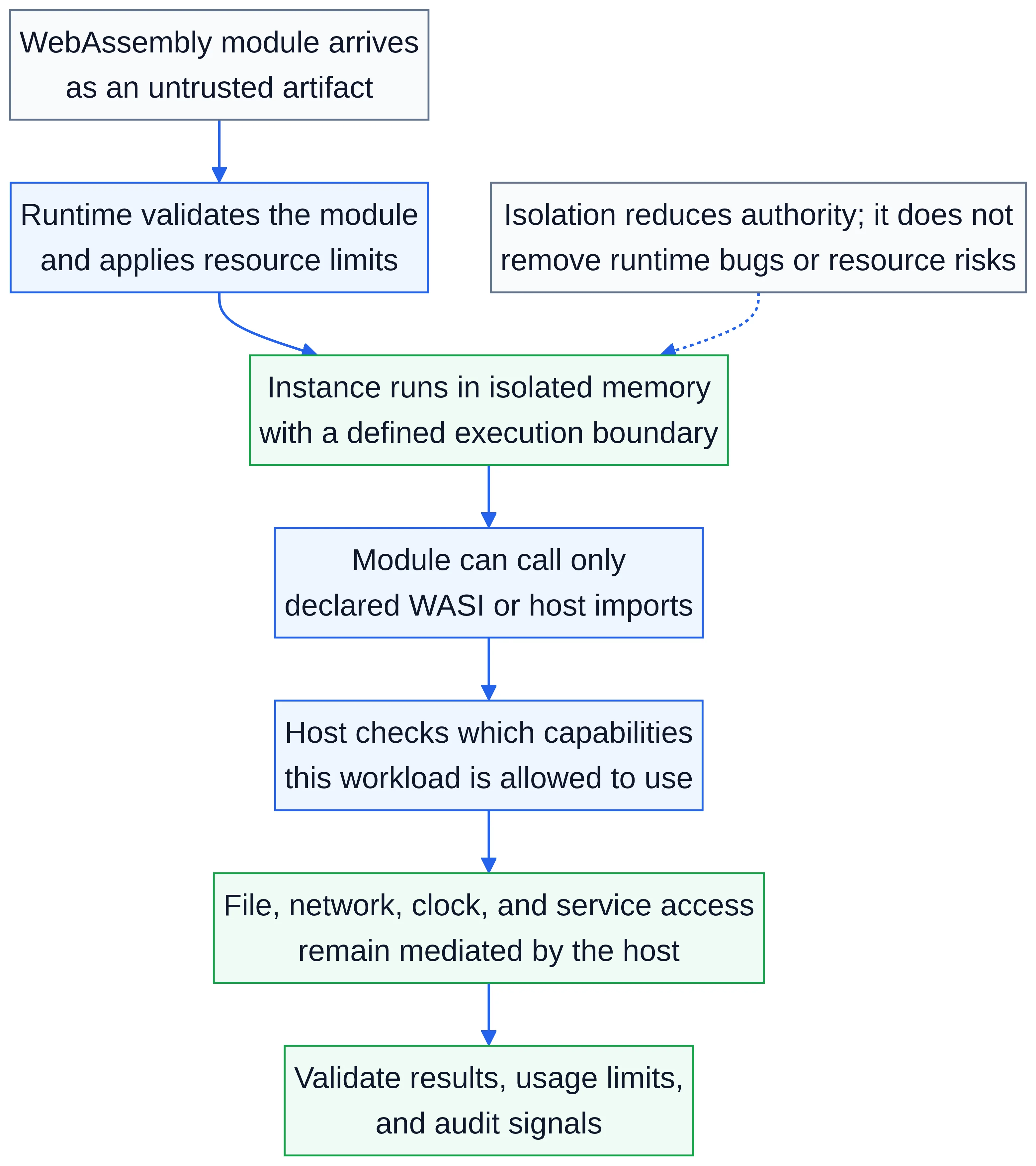 Open the full-size diagram
Runtime sandboxing is defense in depth, not a magic moat
A runtime creates an instance, maps its linear memory, links imports, and mediates execution. The core model prevents a guest from directly dereferencing the host’s native pointers or jumping into arbitrary host code. Wasmtime’s security documentation summarizes the relevant mechanisms as an inaccessible call stack, bounds-checked linear memory, typed control transfers, and imports/exports as the mechanism for interaction with the outside world.Wasmtime security documentation
That description covers the Wasm execution boundary. It does not guarantee that the process containing the runtime is immune to a runtime vulnerability, a malicious host extension, or an operating-system compromise. A high-assurance design can combine Wasm isolation with process separation, operating-system sandboxing, reduced privileges, seccomp or equivalent controls, separate service accounts, resource limits, and network policy. Whether a separate process is justified depends on the trust relationship, the impact of a runtime escape, the cost of context switches, and the quality of the chosen engine’s security maintenance.
Treat host calls as an untrusted crossing in both directions. Before invoking guest code, set fuel, timeouts, memory limits, table or instance limits, and cancellation behavior where the runtime supports them. After a trap, dispose of the instance or reset it according to a documented lifecycle. Do not continue using partially updated state unless the component contract explicitly makes that safe. Make resource exhaustion observable: a timeout and a deliberate trap should not become the same generic 500 error.
A runtime’s configuration is vendor-specific unless a standard says otherwise. The Wasm specification defines what a module means, not whether an engine uses guard pages, compiler hardening, process isolation, JIT caches, or a particular Spectre mitigation. Wasmtime documents guard regions, stack checks, memory zeroing, and selected speculative-execution mitigations as implementation defenses; another runtime may use different techniques or expose different knobs.Wasmtime security documentation Compare threat models and security advisories for the actual engine and version you operate.
The practical security question is not “Is Wasm secure?” It is “What failure remains possible if this module is buggy or hostile?” For a pure function with no imports, the answer may be limited to CPU, memory, and timing abuse. For a component with a database handle, network client, filesystem directory, and logging callback, the answer includes data access, outbound requests, and log injection. Write that answer down before deploying.
Portability has a boundary, and it moves
The core binary format is portable across operating systems and instruction-set architectures, subject to execution environments supporting the model’s assumptions. The official portability guidance lists details such as byte-addressable memory, little-endian ordering, IEEE floating-point behavior, secure isolation, forward progress, and atomic operations.WebAssembly portability A host can emulate some missing behavior, but emulation can be slow or incomplete.
The more common portability break is not the instruction set. It is the API surface. WebAssembly itself specifies an import mechanism rather than a universal set of system calls. Non-browser hosts may implement WASI, POSIX-like libraries, Web APIs, or proprietary interfaces.WebAssembly portability A module tied to a vendor’s HTTP ABI may be highly portable within that vendor’s product and non-portable elsewhere. A WASI component may be portable across runtimes that implement its exact world while remaining unusable on runtimes that only implement Preview 1.
Filesystem semantics are especially revealing. A path may be relative to a preopened directory, a virtual filesystem, or a host-specific mapping. Permissions, symlink behavior, case sensitivity, locking, file timestamps, and durability can differ. Networking varies even more: DNS, proxy configuration, TLS roots, socket options, address families, and egress policy are host responsibilities. A test that passes on a developer laptop does not establish that the same component has equivalent network authority in production.
Time and randomness also weaken assumptions of determinism. Wasm instructions can be deterministic for a given input, but clocks, random sources, scheduling, I/O readiness, and host callbacks are not. A replayable workload should inject a clock and random source or record them at the boundary. If a component uses threads or shared memory, its behavior additionally depends on scheduling and runtime support. Do not describe a networked component as deterministic merely because it is a Wasm binary.
Portability is also constrained by language runtimes and native dependencies. A language may compile to Wasm but rely on a filesystem, threads, dynamic loading, signals, or a garbage collector that the target runtime does not provide. Static linking can make a module self-contained, but it can enlarge the artifact and preserve native assumptions in a different form. Cross-compiling is not the same as porting: exercise the real import contract in continuous integration and run conformance tests on every target runtime.
Performance is a workload property
Wasm can be fast, but “near-native” is not a universal result. The 2017 design paper reported the goals of compact representation, fast validation and compilation, and safe execution. A later large-scale study of substantial programs found WebAssembly slower than native by an average of 45% in Firefox and 55% in Chrome for its SPEC CPU evaluation, with larger peak slowdowns; the authors attributed the gap to both implementation issues and costs inherent in the platform at that time.Not So Fast: Analyzing the Performance of WebAssembly vs. Native Code These results are historical measurements, not a forecast for a 2026 runtime, but they are a useful warning against quoting a single benchmark as a guarantee.
Measure at least four separate costs. Cold start includes reading, validating, compiling, linking, and initializing a module. Steady-state execution depends on the engine’s code generation, memory layout, and the workload’s use of arithmetic, branches, calls, and host functions. Boundary crossings include serialization, copying, resource-handle operations, and async scheduling between components or between guest and host. Resource footprint includes code cache, linear memory, tables, runtime metadata, and language runtime overhead.
A small stateless transformation may benefit from a reusable compiled module and many short-lived instances. A long-running numeric kernel may amortize compilation and achieve strong throughput. A chatty component that calls the host for every byte or database row may lose the benefit through boundary overhead. A service that performs blocking I/O may be limited by the host and network rather than by Wasm instruction speed. Benchmark the whole request path, not only a guest function in isolation.
AOT and prewarming are often useful for predictable latency, but they create rollout and compatibility work. Cache entries need invalidation when the engine, compiler settings, CPU features, or module changes. JIT compilation may be preferable for a heterogeneous fleet when the runtime can compile locally, but it requires capacity for compilation and protection from untrusted code that intentionally triggers expensive compilation.
Use Wasm when the boundary, deployment model, or language interoperability solves a real problem. Do not use it solely because a benchmark shows a favorable median. Set an SLO for p50 and tail latency, measure cold and warm paths, include failure and cancellation cases, and compare against a native library, a process boundary, or a containerized service that solves the same problem.
Supply chain: a portable binary is still untrusted software
A .wasm file can hide substantial source dependencies, generated bindings, bundled libraries, embedded data, and build assumptions. Its binary format does not tell an operator whether the code was built from the intended repository, whether a dependency was compromised, or whether the artifact contains a risky interface. The same is true of a component plus its WIT packages and adapters.
A defensible pipeline records the source revision, compiler and linker versions, target feature set, WIT package versions, dependency lock file, build environment, and artifact digest. Reproducible builds are valuable because an independent build can compare the resulting digest, but reproducibility does not by itself prove that the source was reviewed. Generate a software bill of materials (SBOM) for the source and bundled dependencies, scan native and guest dependencies where scanners support them, and retain the exact bytes promoted to each environment.
Sign the artifact or its OCI representation and verify signatures before execution. Sigstore documents a model in which artifacts are signed, associated with an identity through Fulcio, and recorded in Rekor’s transparency log for auditability.Sigstore overview That is a signing and provenance mechanism, not a runtime authorization policy. Verification should still check the expected publisher, package name, interface/world, digest, and deployment environment. A valid signature on a component that requests a new network capability is a change requiring review, not an automatic approval.
Component distribution tooling can resolve WIT dependencies and write a lock file that pins exact versions. Use that capability, but review transitive components, imported and exported interfaces, lock updates, and generated adapters. Prefer immutable digest references in production and keep a rollback set.
Least authority should be enforced at deployment, not only at build time. A component can be signed and still receive no filesystem or network capability in a staging test. Conversely, a locally built module can be safe for a constrained pure-function use while being unsafe if a deployment template grants it a broad host API. Separate artifact trust from authority policy so that either one can be changed or revoked without rebuilding every module.
Observability must cross the host boundary
A Wasm guest is a useful unit of execution, but it is not automatically a useful unit of diagnosis. OpenTelemetry defines observability through emitted signals such as traces, metrics, and logs; traces connect spans across a distributed request, while metrics aggregate numeric behavior over time.OpenTelemetry observability primer
Instrument the host first. Record module or component identity, immutable artifact digest, interface/world version, runtime and engine version, tenant or request class where appropriate, and the decision that granted capabilities. Measure instantiation count and duration, compilation/cache hits, guest execution time, fuel or instruction budgets if available, memory high-water mark, traps, timeouts, host-call latency, bytes copied, and capability-denied operations. Distinguish a guest error from a host-linking error and a runtime trap.
Propagate trace context through the interface contract rather than relying on ad hoc global state. A host can create a span for the component invocation and child spans for database, filesystem, or outbound HTTP capabilities. A guest that can emit structured events can add domain attributes, but the host must bound log volume and sanitize untrusted text. Do not let a module write arbitrary terminal control sequences or forge privileged audit records.
Profiling also has to account for compilation and boundaries. A flame graph that shows only native engine code can hide time spent validating a module, copying a string into linear memory, waiting for an async resource, or serializing a WIT record. Keep source maps and debug symbols in a restricted artifact store, associate them with the exact digest, and test that production profiling does not expose secrets or tenant data.
Observability is not surveillance of every instruction. Fine-grained guest tracing may be too expensive and may leak application data. Start with boundary events and SLO-relevant measurements. Add guest-level spans for a small set of stable operations, and sample or redact payloads. The goal is to answer why a request failed or slowed without making the sandbox boundary itself a new data-leak path.
A realistic adoption path
Most teams should start with a bounded extension, not a Wasm rewrite of a whole service. A useful decision framework has five gates.
First, define the trust problem. Is the code supplied by another team, a customer, a plugin author, or the same repository? If the code is fully trusted and tightly coupled, a native library may be simpler. If the code is untrusted or must be upgraded independently, Wasm’s validation, memory isolation, and explicit imports may justify the additional runtime.
Second, define the interface. Prefer a small function or component world with explicit inputs, outputs, errors, limits, and ownership. Decide whether data is copied, streamed, or represented by a resource handle. Avoid exposing a general-purpose escape hatch while calling the design least privilege. Version the interface independently from the implementation.
Third, prove the target matrix. Choose a specific core feature set, WASI version, component-model support level, runtime, operating system, and CPU architecture. Build one artifact and run conformance, compatibility, and negative-permission tests on every target. Test missing imports, denied paths, blocked egress, oversized inputs, cancellation, memory exhaustion, and repeated instantiation.
Fourth, measure the complete path. Compare cold and warm startup, throughput, tail latency, memory, boundary traffic, and operational complexity with the best non-Wasm alternative. Include compilation and cache behavior in the deployment model. Establish a rollback path before routing meaningful traffic.
Fifth, operate it as software, not as a file. Pin digests, verify provenance, scan dependencies, patch the engine, rotate and review capability policies, collect host and guest telemetry, and rehearse revocation. Treat a runtime upgrade as a security and compatibility event. Keep the previous engine and artifact available long enough to recover without an emergency rebuild.
This path leads to three sensible adoption patterns. Plugins and policy engines are a strong starting point when calls are bounded and the host can expose a small API. Components inside a service make sense when teams need language-neutral interfaces or independently released transformations, provided boundary overhead is acceptable. Wasm as the primary application runtime is justified only when the team controls the runtime matrix, has a compelling portability or isolation requirement, and is willing to own the still-evolving WASI and component ecosystem.
Wasm is a particularly poor fit when the workload requires unrestricted operating-system access, a large unmodified native stack, kernel features, specialized device drivers, or tight coupling to a single platform’s APIs. A container or a native process may provide a clearer operational model. A Wasm component can also live inside a conventional service; adopting the format does not require adopting every component registry, edge platform, or vendor framework.
Conclusion
WebAssembly beyond the browser is best understood as a portable execution format plus explicit host contracts. Its core semantics create a meaningful memory and control-flow boundary. WASI can make system authority explicit. The Component Model can make language-neutral composition explicit. None of those layers, by themselves, supplies a complete operating system, a universal runtime, a performance guarantee, or a trustworthy software supply chain.
The strongest designs keep the claims narrow: this artifact validates against this feature set; this component implements this versioned world; this host grants these capabilities; this runtime applies these limits; and this pipeline verifies this digest. With those claims measured and operated, Wasm can be a practical boundary for selected server and edge workloads. Without them, “portable and secure” is only a binary file with a hopeful description.
References and further reading
- WebAssembly specifications
- WebAssembly security model
- WebAssembly portability
- WebAssembly System Interface repository and proposals
- WASI security and capability model
- WIT design guide
- Component distribution and fetching guidance
- Wasmtime security documentation
- Bringing the Web up to Speed with WebAssembly
- Not So Fast: Analyzing the Performance of WebAssembly vs. Native Code
- OpenTelemetry observability primer
- Sigstore overview

Blockchain beyond the ledger: consensus, trust, and real-world trade-offs
How blockchain consensus, finality, governance and data availability work—and when a shared ledger is justified over a conventional database.

Verifiable digital credentials: privacy, interoperability, and trust frameworks
How verifiable credentials work across issuers, holders and verifiers, with practical guidance on privacy, interoperability and trust.