Edge computing without the buzzwords: placement, state, and operations
 Founder · Domain Strategist · Author20 Oct 2026 · 19 min read

In this article · 13 sections
- Start with the constraint, not the location
- A practical placement model
- State is the difficult part
- Data residency is a placement rule, not a network diagram
- Disconnected operation is a product behavior
- Orchestration must respect a weak control plane
- Updates are part of the runtime contract
- Observability must work locally first
- Failure handling starts with the node’s limits
- Security follows the workload and the boundary
- A decision framework for edge, region, or central cloud
- Conclusion
- References and further reading
Edge computing is often described as “putting compute closer to the user.” That is directionally correct, but it leaves out the decisions that make an edge system dependable. A service can run beside a machine, in a shop, at a cell site, in a branch office, or on a device and still fail its purpose if the wrong state is local, the control plane assumes a permanent connection, or an update cannot be rolled back safely.
A more useful definition is operational: edge computing is a distributed arrangement in which some application work, data, or control is placed near the source or consumer because distance, bandwidth, autonomy, policy, or physical context matters. “Near” is relative to the constraint. A gateway on a factory floor may be near enough for a control loop; a regional facility may be near enough for a customer-facing API; a central cloud may be the only sensible place for global analytics and long-lived records.
This article is scoped to information available on 20 October 2026. It focuses on architecture rather than a particular vendor. ETSI’s Multi-access Edge Computing (MEC) specification is a useful reference model: a host contains a platform, applications, and virtualisation infrastructure, while system-level management includes an orchestrator with a view of the wider system. That is a standardised architectural vocabulary, not a promise that every commercial “edge platform” implements the same components or interfaces. (ETSI GS MEC 003 V3.1.1)
Start with the constraint, not the location
The first design question is not “which edge product should we buy?” It is “what must happen before which deadline, with which information, under which failure conditions?” A placement decision follows from that contract.
Break the path into budgets. A request may spend time acquiring data, waiting in a queue, crossing a local network, traversing a wide-area network, executing code, reading state, and returning a result. If a device must react within 50 milliseconds, a round trip to a distant region may consume too much of the budget even when the average network time looks acceptable. If the requirement is five seconds, placing the same function at a site may add cost and operational complexity without improving the outcome. Measure the tail, not only the average: p95 and p99 latency expose queueing and congestion that a p50 hides.
Latency also has a meaning beyond milliseconds. A response can be late because it waited for a cloud dependency, because the service had to fetch a cold model or data set, or because the system retried after a lost connection. Write down whether the target includes device-to-edge transit, admission, processing, storage, and acknowledgement. Define what happens when the target cannot be met: reject, use a degraded result, apply the last safe policy, or wait for central confirmation.
Bandwidth and data volume can be stronger placement drivers than latency. A camera, industrial sensor, or vehicle can produce more data than a central system needs to retain. An edge process can extract events, compress samples, or discard data under a retention policy. That is not automatically privacy-preserving: a derived event may still identify a person, location, or process.
The IRTF’s IoT edge research draft describes placement as a choice based on available resources, the location of inputs and sinks, latency, privacy, availability, energy, and network efficiency. Because it is an Internet-Draft rather than an Internet Standard, use it as design guidance, not as a conformance requirement. (IRTF IoT edge draft)
A practical placement model
Treat an application as a graph rather than a single deployable box. Nodes in the graph include device adapters, protocol translators, filters, rules, APIs, workers, databases, caches, message brokers, and control functions. Edges in the graph carry data and state. For every node, record its inputs, output deadline, resource needs, failure behavior, data classification, and placement candidates.
A simple decision sequence works well:
- Set the deadline and consequence. Is late output inconvenient, financially costly, unsafe, or unacceptable? A safety response and a recommendation have different fallback rules even if both are called “real time.”
- Identify the minimum local function. Place only what must run locally to meet the contract. A local decision may need a small rules engine and a cached policy, not the full application stack.
- Classify the data. Separate raw data, derived features, commands, identities, audit records, and operational telemetry. Each can have different residency and retention requirements.
- Choose the authority for each state. “Stored at the edge” is not the same as “authoritative at the edge.” Define who can commit, who can approve, and how conflicts resolve.
- Specify the disconnected behavior. State what continues, what pauses, what queues, what expires, and what is forbidden when upstream is unreachable.
- Price the operational burden. Include site hardware, spares, physical access, patching, certificates, observability, bandwidth, and incident response. An extra millisecond saved is not free.
- Test the failure envelope. Remove the WAN, fill the disk, skew the clock, revoke a credential, restart the process, and install a bad update in a test environment. Placement is correct only if the whole behavior remains acceptable.
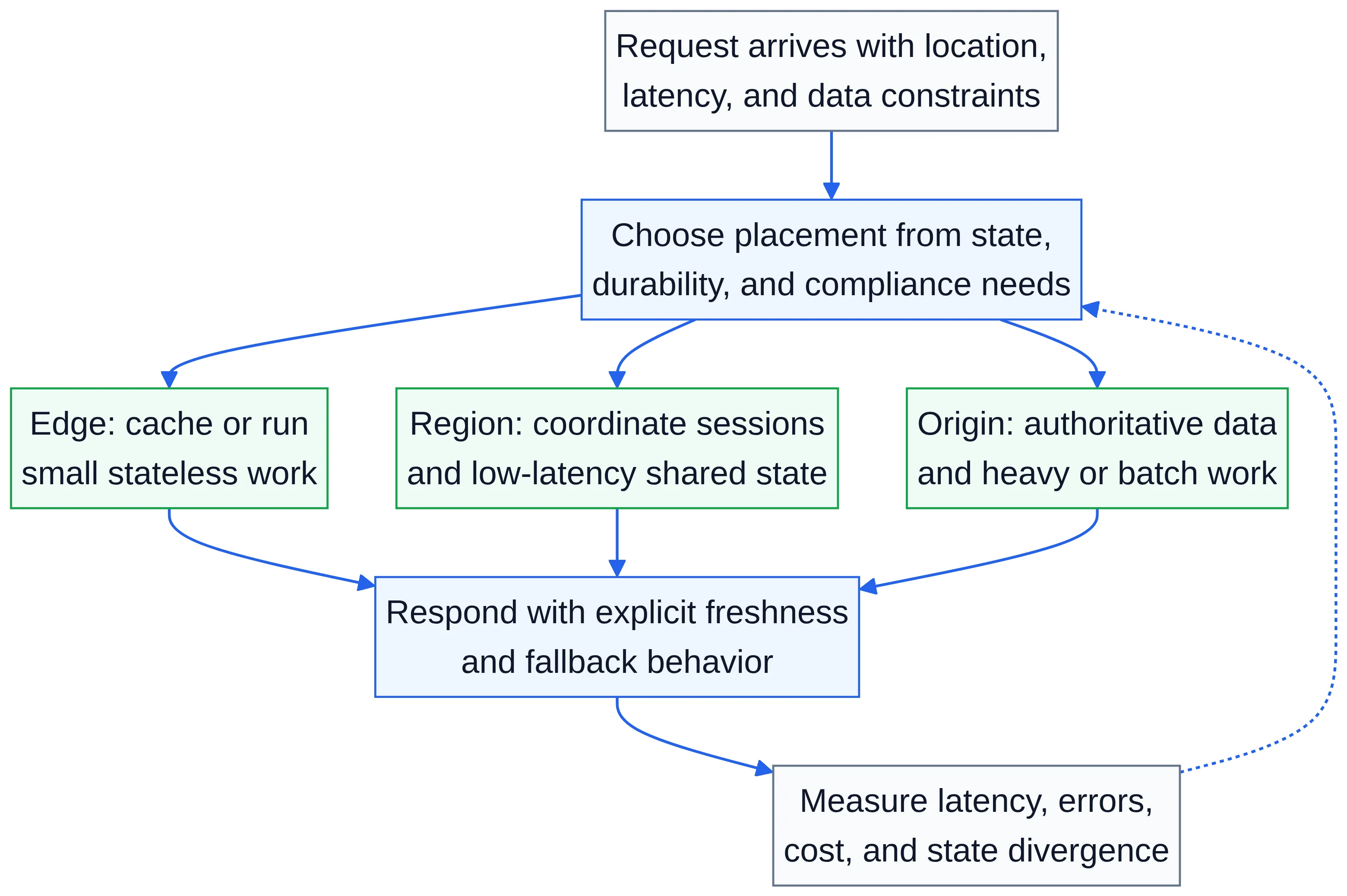 Open the full-size diagram
State is the difficult part
Stateless code is easy to move because a new instance can start with configuration and receive a request. Real edge systems rarely have only stateless work. They have device sessions, sequence numbers, local policy, actuator state, caches, queues, credentials, and partially processed data. Moving the code without deciding what happens to that state creates a system that is fast when connected and ambiguous when it is not.
Use four questions for every piece of state:
- Who owns it? An edge node, a site, a region, a tenant, or a central service?
- How fresh must it be? A cached catalogue can be minutes old; a machine interlock may need the latest local signal.
- What happens during a partition? Can the edge accept writes, only read, or neither?
- How is it reconciled? Last-write-wins, a version check, a domain-specific merge, a conflict-free data type, or manual review?
A cache is a copy with an expiry policy. A durable local database is a record with a recovery and backup policy. A queue is a promise to deliver work later, subject to limits, deduplication, and expiry. Do not label all three “local state” and assume they have the same guarantees. The IRTF draft makes the same distinction between local storage and caching: caches are generally temporary and need not provide persistence, while local storage raises consistency, freshness, reliability, privacy, and retention questions. (IRTF IoT edge draft)
Local state should be deliberately bounded. Set maximum queue age, disk quota, record count, and replay rate. If a disconnected site can produce data faster than it can later upload, an unbounded queue merely postpones failure until the disk is full. Prefer an explicit loss policy: retain critical events, sample routine telemetry, aggregate repeated values, or stop accepting work before storage becomes unsafe.
State ownership is often more important than database technology. Suppose a site can approve a local machine action while the region is unreachable. The design must say whether that approval remains valid after reconnection, how long it lasts, and whether a central policy change can revoke it. A local copy of a central policy is useful only if it carries a version, effective time, expiry, and issuer identity. “The edge has the configuration” is not enough.
Consistency should match the business action. A local counter that is eventually reconciled can tolerate concurrent increments if the merge is defined. A permission, credit balance, or duplicate-sensitive command usually needs a stronger authority or a reservation protocol. Do not promise “eventual consistency” without naming what may be temporarily inconsistent and what the user or machine will observe.
Data residency is a placement rule, not a network diagram
Data residency means where data is stored or processed. Data sovereignty adds the legal and governance regimes that may apply because of where the data or organisation is located. They are related but not interchangeable. Keeping data on a local server does not by itself satisfy a law, and sending only a hash to a region may still reveal sensitive information through identifiers, timing, or reversibility.
Start with a data inventory. Mark personal data, operational secrets, safety records, export-controlled material, customer content, telemetry, and derived data. For each class, define allowed locations, allowed operators, retention, encryption, access logging, deletion, backup, and cross-border transfer rules. Include replicas and support paths. A regional backup or a vendor troubleshooting dump can move data outside the assumed boundary even when the primary database stays local.
Regulation is scope-dependent. The EU General Data Protection Regulation, for example, applies to processing in the context of an establishment in the Union and can also apply to processing by an organisation outside the Union when it offers goods or services to people in the Union or monitors their behaviour there. That is not a blanket statement that every EU-originated byte must remain in an EU edge site. Consult the applicable law, contracts, sector rules, and transfer mechanisms for the actual processing. (GDPR, Articles 2–4)
A good architecture can keep raw data local while exporting a carefully defined derivative. That derivative still needs a classification and threat analysis. Redaction, aggregation, tokenisation, and retention limits reduce exposure but do not prove anonymity. Keep a lineage record so operators can answer which local input produced a central record and which policy permitted the transfer. Remote debug access is also a data flow; use time-bounded access, approval, audit, and a locally enforceable deny switch.
Disconnected operation is a product behavior
Every edge system should have an explicit partition mode. A WAN outage is not one event: DNS may fail while a private link remains available; the control plane may be unreachable while local devices work; a certificate may expire during a long outage; clocks may drift; and the upstream may return with stale commands. Test these as separate conditions.
The local data plane should not need a central control-plane round trip for work whose deadline and safety case require autonomy. Local services need enough configuration, credentials, models or rules, and device metadata to start and continue. They also need leases or expiries so an old configuration does not run forever. “Offline capable” means more than retrying a request; it means the intended state machine is defined without the network.
Classify actions in partition mode:
- Continue: safe, bounded functions such as local filtering or a short-lived control loop.
- Degrade: use a conservative rule, lower resolution, or stale-but-labelled data.
- Queue: retain an idempotent event for later delivery with a size and age limit.
- Pause: stop work that needs fresh central authority.
- Deny: refuse commands that would be unsafe or violate policy without current verification.
Reconnection is a protocol, not a toggle. On return, authenticate both sides, exchange versions, check clock and policy validity, drain queues at a controlled rate, deduplicate messages, reconcile conflicts, and record what was rejected. Do not let a reconnect storm turn every site into a synchronized overload. Backoff with jitter, cap replay, and preserve priority for safety and control traffic.
KubeEdge is one example of a project that explicitly targets cloud-edge coordination, metadata synchronisation, and autonomous edge operation during disconnection. Those are capabilities of that open-source system, not properties of Kubernetes or of edge computing in general. Verify the exact version, supported workloads, and recovery semantics before treating a product claim as an architecture guarantee. (KubeEdge documentation)
Orchestration must respect a weak control plane
Central orchestration is attractive because it gives one place to declare desired state. At the edge, it must cope with intermittent connectivity, heterogeneous hardware, small sites, changing topology, and partial success. The management layer should therefore distinguish desired state, observed state, and last-known state. A central dashboard that shows a green site because it has not heard bad news is not observing the site.
Use a hierarchy. A fleet controller can select a release and policy. A regional controller can schedule across sites and hold artifacts. A site agent can apply changes, manage local dependencies, and continue with the last accepted configuration. The agent should be able to report a signed or otherwise authenticated status that includes revision, health, resource pressure, clock state, and the age of its connection to upstream.
Placement needs explicit constraints. An application description should be able to express required resources, supported CPU architecture, device access, locality, maximum latency, data restrictions, dependency versions, and whether it may run during a partition. ETSI’s MEC model gives applications requirements such as resources, maximum latency, and required services, and gives the orchestrator a view of hosts, resources, services, and topology. That is a useful vocabulary; the scheduling algorithm and deployment semantics remain implementation choices. (ETSI GS MEC 003 V3.1.1)
Avoid turning every site into a miniature central cluster. A lightweight agent and a small, well-defined runtime may be more reliable than replicating a control plane that expects fast, stable consensus. Use the simplest abstraction that supports the application’s lifecycle, isolation, and rollback needs. Containers are common, but virtual machines, native processes, rules engines, or appliance software may be appropriate for constrained or specialised nodes.
Control-plane retries must be idempotent. Applying “set desired revision to 42” twice should be safe. Avoid commands whose meaning depends on having received every earlier message. Store an operation identifier and result locally so the agent can answer a retried request without repeating a non-idempotent action.
Updates are part of the runtime contract
A fleet of edge nodes turns every release into a distributed change. An update can alter code, schemas, device drivers, policies, certificates, and data formats. Plan the order and rollback path before shipping the first version.
Use immutable, attestable artifacts with a clear compatibility statement. Verify the artifact and its metadata at the edge, not only at the central registry. Secure update design must defend against more than a fake package: the Update Framework documentation lists rollback, freeze, mix-and-match, wrong-file, malicious-mirror, and key-compromise attacks among the threats to update systems. It recommends properties such as integrity, freshness, expiring trust, compartmentalised roles, and compromise-resilient key management. (The Update Framework security model)
Roll out in rings. Start with a lab or representative canary, then a small group of sites, then a broader cohort. Select canaries by hardware, network, geography, workload, and risk rather than by convenience. A disconnected site may remain on the old version for days, so maintain protocol compatibility across versions and set a maximum supported skew. Never make the update itself depend on a central connection that the application is designed to survive without.
A rolling update is not automatically safe for edge workloads. Kubernetes Deployments, for example, support controls for maximum unavailable and maximum surge, readiness, progress deadlines, revision history, and rollback. Those semantics apply to a Kubernetes Deployment; they do not automatically account for a single physical gateway, a stateful local database, a device’s safe shutdown procedure, or a site that cannot download a second image. (Kubernetes Deployment documentation)
For stateful services, make migrations expand-and-contract where possible: add a backward-compatible field, deploy readers and writers that understand both forms, migrate data in bounded batches, then remove the old form later. A binary rollback is not enough if the new version has irreversibly changed the local data. Keep a last-known-good image, configuration, and state recovery procedure on the node, with enough disk reserved to use them.
Updates also include revocation. Define what happens when a credential, model, rule, or package is withdrawn while a site is offline. A fail-open policy may preserve local availability but extend exposure; a fail-closed policy may stop a physical process. Choose per function and document the authority and expiry behind the choice.
Observability must work locally first
Observability is the ability to understand a system from its emitted telemetry. It is not the same as collecting logs in a central dashboard. An edge design must remain diagnosable when the dashboard is unreachable, when clocks disagree, and when sending every event upstream would consume the bandwidth the application needs.
Instrument three signals: metrics for quantities and rates, logs for discrete records, and traces for a request’s path across components. OpenTelemetry defines APIs, SDKs, data models, context propagation, protocols, and semantic conventions for these signals. It is a project specification and ecosystem, not a guarantee that a particular edge vendor exports or retains all signals in the same way. (OpenTelemetry specification)
Keep a local operational buffer. It should hold enough data to diagnose a recent incident without becoming an unbounded second database. Export summaries and high-value exemplars upstream; retain detailed payloads only where policy permits. Use local sampling that preserves errors, slow requests, state transitions, update events, resource pressure, and security decisions. Record event time and ingest time so operators can see delayed telemetry after reconnection.
Every event should identify the site, node, workload revision, device or tenant scope where allowed, and correlation or trace identifier. Make the identifiers stable across a local-to-regional hop, but do not put personal or secret data into them. Synchronise time when possible and monitor clock offset. If precise time is unavailable, use monotonic durations for local latency and clearly label wall-clock timestamps as uncertain.
Define edge-specific health, not just process liveness. A process can be alive while its device connection is stale, its policy expired, its disk is full, its queue is dropping records, or its upstream certificate is invalid. Expose freshness of configuration, last successful reconciliation, local queue age, clock status, storage headroom, resource pressure, and update revision. Alert on missing heartbeats with a distinction between “site is down” and “site is disconnected but operating.”
Failure handling starts with the node’s limits
Distributed failure is normal at the edge because there are more nodes, more physical environments, and more independent links. Build explicit limits and failure domains. A site should not lose every function because one optional analytics container consumes all memory or disk. Reserve resources for the operating system, device agent, control path, and recovery image. Apply quotas and priority so critical local work can survive contention.
Watch memory, storage, inodes, process identifiers, temperature, power, and network queues. Kubernetes’ kubelet, for example, exposes node-pressure signals and can evict workloads when configured thresholds are met; its documented defaults and eviction behavior are Kubernetes-specific and must not be presented as universal edge policy. (Kubernetes node-pressure eviction)
Use bulkheads: isolate tenants, services, and device classes so a failing workload has a bounded blast radius. Add circuit breakers around upstream dependencies. Apply timeouts and bounded retries; retries without a deadline amplify an outage. Use backpressure when a downstream queue is full. Idempotency keys or deduplication are essential when messages can be retried after an uncertain acknowledgement.
Define failure actions by consequence. A temperature sensor may continue locally with a conservative limit when the cloud is unavailable. A billing event may queue but must not be counted twice. A control command may be rejected if the policy is stale. A noncritical video stream may drop frames. These are domain decisions, not generic “high availability” features.
Recovery needs evidence. Preserve the last known policy, update revision, queue statistics, resource-pressure events, security audit records, and a bounded diagnostic snapshot. On reboot, replay only messages that are still valid and safe. Treat a corrupted local database as a recovery scenario, not as an invitation to reconstruct authority from an arbitrary cache. Back up encrypted state where policy permits, and regularly practice restoring a representative node.
Security follows the workload and the boundary
An edge node is physically exposed, intermittently connected, and often more heterogeneous than a central cluster. Assume a node can be stolen, tampered with, misconfigured, or left unpatched. Use hardware-backed keys or a secure element where the threat model justifies it, encrypt local storage, minimise retained data, and make the device fail safely when credentials are revoked or integrity checks fail.
Do not use “inside the site” as an implicit trust boundary. NIST’s Zero Trust Architecture says that access should not be trusted merely because a user or asset is on a local network or is enterprise-owned; authentication and authorisation are separate decisions made before a session, and protection focuses on resources rather than network segments. That principle maps naturally to edge systems with device, workload, operator, and site identities. (NIST SP 800-207)
Give each workload the minimum device, filesystem, network, and secret access it needs. Segment southbound device traffic from management traffic. Authenticate and authorise both directions: the edge must verify the control plane, and the control plane must verify the node and workload. Rotate certificates without requiring an always-on central connection. Use short-lived operator access with approval and audit, rather than permanent shared passwords.
Protect the control plane as carefully as the data plane. A compromised orchestrator can deploy malicious code fleet-wide; a compromised site agent can falsify health and consume credentials. Separate signing roles for artifacts, policy, and fleet administration. Require review or quorum for high-impact changes. Keep an immutable audit trail where feasible, and make local audit records tamper-evident before they are forwarded.
Security and availability can conflict during disconnection. Decide the maximum offline lease for each capability, the emergency override process, and the evidence required to resume. A local allowlist may keep a factory running, but an indefinite allowlist turns temporary autonomy into a permanent bypass. Make expiry observable and test it.
A decision framework for edge, region, or central cloud
Use a three-tier worksheet for each component. The following questions are concrete enough to put into an architecture review or deployment manifest.
Put it at the edge when: the action has a hard local deadline; the required inputs are local; the function must continue through a bounded upstream outage; moving raw data is expensive or disallowed; or the physical context is unavailable elsewhere. Keep the local implementation small, deterministic where safety matters, and explicit about stale policy and expiry.
Put it in a region when: several nearby sites benefit from shared capacity; the function needs lower latency than a distant central cloud but does not need to sit beside a device; regional aggregation reduces duplicate work; or the region is a useful failure domain for failover and coordination.
Put it in the central cloud when: the function needs a global dataset or cross-site view; it is batch-oriented; it benefits from large, stable pools of compute; it owns long-term governance records; or its latency and partition requirements permit a remote dependency. Central placement is often appropriate for fleet policy authoring, release promotion, global reporting, historical analytics, and training.
For each candidate, score the component against six dimensions: deadline, data movement, local autonomy, state authority, operational cost, and blast radius. Reject a placement if it violates a non-negotiable constraint, even if it wins the other scores. Then document a fallback placement. A component that normally runs in the region may have a smaller local mode; a central analytics job may be delayed; a local rule may be frozen until its lease expires.
Consider a hypothetical cold-storage site. A local agent can read sensors, enforce a conservative temperature rule, and buffer signed events. A regional service can coordinate several sites and provide a nearby operator interface. The central service can manage policy versions, fleet-wide reporting, and long-term analysis. If the site loses its uplink, the local rule continues only until its signed lease expires; events are queued within a disk budget; regional and central dashboards show the site as disconnected rather than healthy by omission. This is an example of a contract, not a claim about a particular deployment.
Finally, write the decision in terms that can be tested. “Low latency” becomes a percentile and measurement boundary. “Offline capable” becomes a list of actions and lease durations. “Data stays local” becomes an inventory of raw, derived, replicated, logged, and backed-up data. “Safe updates” becomes a canary, compatibility window, rollback condition, and recovery drill. If a requirement cannot be observed or tested, it is not yet an architecture decision.
Conclusion
Edge computing is not a synonym for a smaller cloud. It is a way to distribute responsibility across places that have different latency, state, policy, capacity, and failure characteristics. The hard work is deciding what must be local, what may be stale, who is authoritative, what happens during a partition, and how an operator can update and diagnose thousands of imperfectly connected sites.
The reliable pattern is conservative: put the minimum deadline-sensitive function near the source, keep state ownership explicit, export only governed data, make autonomy bounded and observable, and keep global coordination where a wider view is valuable. Choose standards and open specifications for the contracts they actually define, and treat vendor behavior as a versioned implementation detail to verify. With those disciplines, “edge” stops being a buzzword and becomes a set of testable placement and operations choices.
References and further reading
- ETSI GS MEC 003 V3.1.1 — Multi-access Edge Computing framework and reference architecture
- IRTF draft — IoT Edge Computing: Challenges, Functions and Security Considerations
- KubeEdge — Kubernetes Native Edge Computing Framework
- OpenTelemetry Specification
- Kubernetes Deployments — rolling updates and rollback
- Kubernetes Node-pressure Eviction
- NIST SP 800-207 — Zero Trust Architecture
- Regulation (EU) 2016/679 — General Data Protection Regulation
- The Update Framework — Security
- NIST — Formal Definition of Edge Computing: An Emphasis on Mobile Cloud and IoT Composition

Operating DNS at the edge
A research-grounded guide to operating DNS with anycast: routing realities, node readiness, monitoring, capacity, deployment, and incident response.
Building DNS that survives bad days
What we learned designing DNS architecture that keeps resolving when providers, links and regions fail at the same time.

A TTL strategy that actually works
Stop guessing TTL values. A practical framework for choosing record lifetimes based on how fast you need to fail over.