Blockchain beyond the ledger: consensus, trust, and real-world trade-offs
 Founder · Domain Strategist · Author20 Oct 2026 · 18 min read

In this article · 12 sections
- Start with the replicated state, not the block
- Consensus is an agreement under assumptions
- Finality: when is a write safe to act on?
- Decentralisation is a budget of trade-offs
- Data availability is not data permanence
- Smart contracts are software with unusual failure modes
- Privacy conflicts with transparent replication
- Governance is part of the architecture
- When a conventional database is the better choice
- A practical decision and implementation framework
- Conclusion
- References and further reading
A blockchain is not simply a database with a longer audit trail. It is a way for several parties to maintain a shared state when at least some of them may not trust one another, while giving each participant enough evidence to check the history for themselves. That bargain is useful in a narrow class of coordination problems. It is also expensive, constrained by network timing, and often misunderstood.
The practical question is therefore not “How do we put this data on a blockchain?” It is: Which parties need a shared state, what can they assume about one another, and which costs are justified by removing or limiting a central operator? If one accountable organisation already owns the system and can grant, correct, delete, back up, and query data efficiently, a conventional database is usually the more capable choice.
This article describes the architecture behind the label, not a particular token or vendor. Examples use Bitcoin, Ethereum, Hyperledger Fabric, PBFT, Raft, and PostgreSQL because their public specifications make the trade-offs concrete. Those systems are not interchangeable. Unless stated otherwise, claims about them are scoped to the documentation and specifications available on 20 October 2026.
Start with the replicated state, not the block
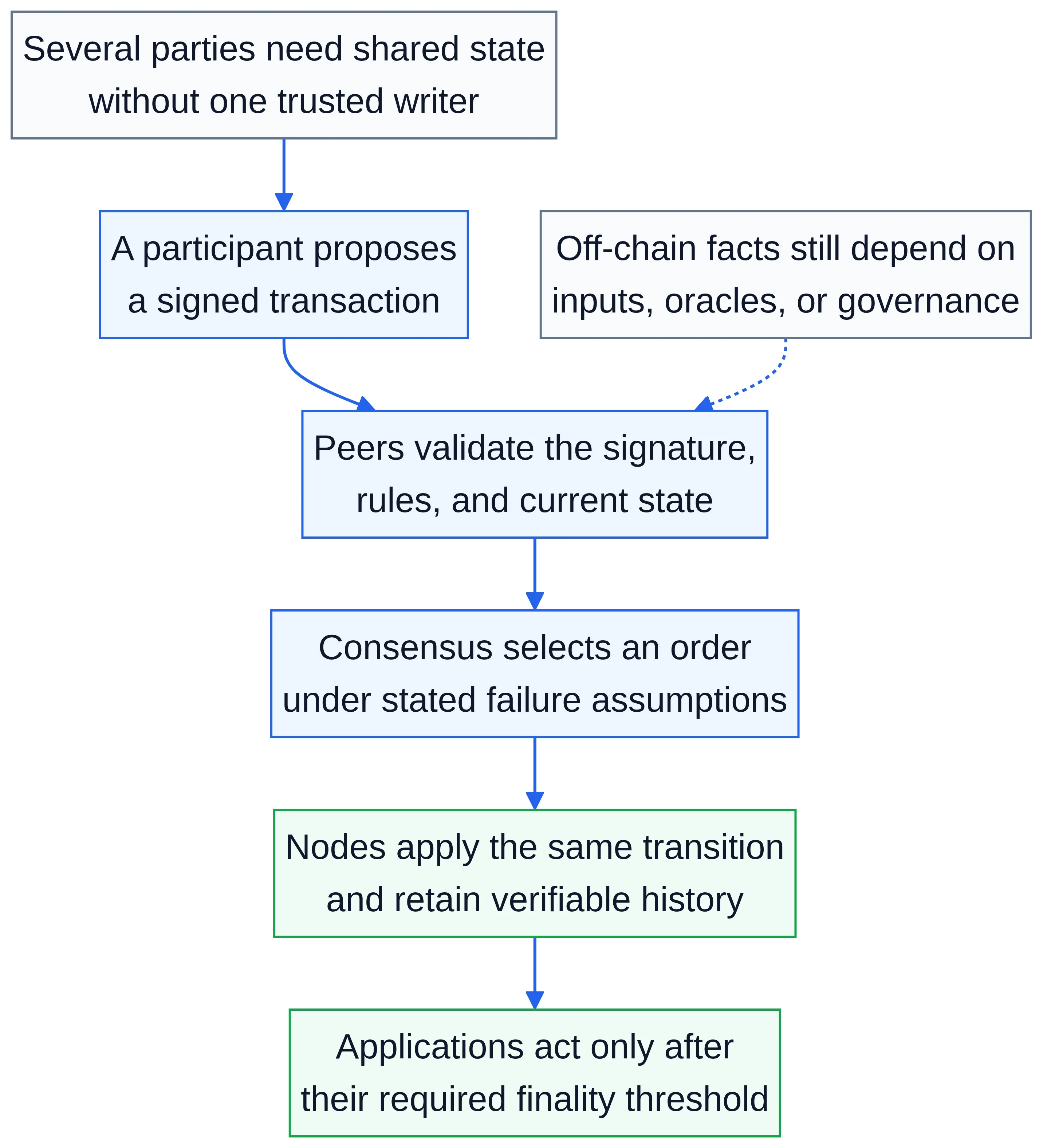
At the centre of a ledger is a state machine. A transaction is an input; the state machine applies valid inputs in an agreed order; the resulting state is replicated to other machines. A simple payment ledger might store ownership balances. A richer system might store account state, permissions, or executable rules. A block is a packaging and ordering device, not the thing that makes the system trustworthy.
Replication means that more than one node keeps enough information to reconstruct or verify the state. It improves resilience to a failed machine and gives participants independent evidence. It also creates work: data must be transmitted, validated, stored, indexed, backed up, and sometimes re-executed by multiple nodes. Replicas do not magically make bad input true. They make it harder for one operator to rewrite an agreed history without detection, provided the protocol's assumptions hold.
A useful distinction is between integrity, availability, and authority. Cryptographic hashes and digital signatures help a node detect changed bytes and authenticate a key holder. Replication helps a service continue when some machines fail. Consensus chooses an order or state among competing proposals. None of these proves that an off-chain fact is true. A signed statement that a shipment was delivered proves that a key signed those bytes; it does not prove that a human actually delivered the shipment. The bridge from real-world facts to ledger inputs is an oracle, an administrator, a sensor, or a legal process.
 Open the full-size diagram
NIST's Blockchain Technology Overview describes blockchains as tamper-evident and tamper-resistant distributed ledgers, usually without a central repository or authority. “Tamper-resistant” is deliberately weaker than “immutable.” A history can be reorganised under a protocol's threat model, and an application can contain an administrative key, upgrade path, or recovery process that changes what users experience. Immutability is a system property with conditions, not a universal promise.
Three kinds of replication
It helps to separate three designs that are routinely called blockchain.
In a permissionless public network, a participant may join without a prior business relationship. The protocol must cope with identities that are cheap to create, unknown operators, strategic behaviour, and nodes that disappear. Bitcoin's original design uses proof-of-work: miners expend computation to propose blocks, and nodes follow the chain with the greatest accumulated work. Its security argument assumes that honest participants control a majority of the relevant computing power, as explained in the Bitcoin paper. A payment becomes more difficult to reverse as additional blocks are built after it, but the paper's model is probabilistic rather than a universal instant-finality guarantee.
In a permissioned network, membership is controlled. Organisations have identifiable certificates, contractual relationships, and a process for adding or removing operators. Hyperledger Fabric's architecture documentation describes peers, an ordering service, membership services, endorsement policies, and configurable database storage. It can use crash-fault-tolerant or Byzantine-fault-tolerant ordering depending on the trust model. That is still distributed replication, but it is not the same governance problem as an open cryptocurrency network.
A third design is a replicated database cluster. Its nodes may be spread across zones or regions, and it may use Raft or another consensus algorithm to keep a log coherent. Raft's original paper describes leader election, log replication, safety, and membership changes for crash faults. Such a cluster may be highly reliable without being decentralised: one company can own every node, select the software, and change the service policy. Replication and decentralisation are related but not synonyms.
Consensus is an agreement under assumptions
Consensus is the protocol by which replicas agree on a value, a sequence of commands, or a state transition. It is not a general-purpose vote on reality. A protocol typically promises some form of safety—honest nodes do not accept conflicting histories—and liveness—valid work eventually makes progress—under an explicit fault and network model.
The model matters more than the word “consensus.” A crash fault is a stopped or unreachable process. A Byzantine fault is arbitrary behaviour: a node may lie, equivocate, send different messages to different peers, or collude with others. A protocol built for crash faults can be simpler and faster, but it is not automatically safe against malicious members. The FLP result shows that no deterministic asynchronous protocol can guarantee termination in the presence of even one faulty process. Real systems get around that limit with assumptions such as time bounds, failure detectors, randomness, synchrony after a period, or a weaker definition of progress.
Proof-of-work and proof-of-stake
Proof-of-work turns resource expenditure into a way to weight competing histories. In Bitcoin's construction, a node validates transactions and blocks, while miners search for a nonce that satisfies a hash target. Rewriting an old block requires redoing its work and catching up with the honest chain. The result is censorship resistance against a single administrator, but it consumes energy and makes block confirmation probabilistic. The relevant resource is not “number of users” or “number of nodes”; it is control of computational work and the network's ability to propagate blocks.
Proof-of-stake replaces ongoing computation with a capital-at-risk mechanism. Ethereum's proof-of-stake documentation says validators deposit stake, check and re-execute proposed blocks, and attest to the chain. Ethereum divides time into slots and epochs and uses checkpoint votes. A pair of checkpoints with votes representing at least two-thirds of staked ETH can become justified and finalised; conflicting behaviour can be penalised by slashing. These details are Ethereum-specific. “Proof-of-stake” is a family of designs, not one standard operating procedure.
Both mechanisms bind security to an external scarce resource—electricity and hardware in one case, capital and penalty rules in the other. Neither removes governance. Hardware concentration, custodial staking, validator software concentration, client bugs, fee markets, and social responses to an attack all affect the practical distribution of power. A protocol can be open to anyone while its block production, access gateways, software clients, or economic influence become concentrated.
BFT replication and quorum
In a known committee, Byzantine fault-tolerant replication can provide strong agreement with fewer probabilistic assumptions. The original Practical Byzantine Fault Tolerance paper describes state-machine replication that preserves safety and liveness when no more than one-third of replicas are faulty, with eventual timing assumptions for progress. The familiar “3f + 1” rule is not a universal blockchain law. It is a property of a class of BFT protocols and their quorum construction.
A permissioned committee may therefore deliver low-latency, deterministic finality while accepting that the committee is selected by an administrator or consortium. That can be exactly right for a clearing network in which the members are known and subject to a legal agreement. It does not provide the same open participation or censorship-resistance objective as a permissionless network. The question is not which system has the most replicas, but which parties can block, rewrite, censor, or change the rules.
Finality: when is a write safe to act on?
Finality is the point at which a protocol says a decided history cannot be reversed under its stated assumptions. The term is used too loosely, so decision-makers should ask four questions: final for whom, under which fault model, after what evidence, and with what recovery path?
A proof-of-work chain generally offers probabilistic finality. A block that has one successor can still lose a fork race; more successors make the probability of reversal smaller under the honest-majority assumption. An exchange may therefore wait for a policy-defined number of confirmations. That policy is an operational risk decision, not a cryptographic constant.
A quorum protocol can offer deterministic or economic finality. In a BFT committee, once a non-conflicting quorum certificate exists, honest members should not be able to certify two conflicting values unless the fault threshold is exceeded. In Ethereum's current proof-of-stake design, finality is economic: reverting a finalised block would require behaviour that incurs substantial stake destruction, according to the Ethereum documentation. A network partition or insufficient participation can stop finality even while previously finalised data remains safe. Safety and progress can fail in different directions.
Finality does not settle application disputes. A final transaction can record an incorrect price, a stolen private-key signature, or a fraudulent oracle update. It can also create an irreversible privacy problem. Application design should specify reversal, refund, key rotation, incident response, and dispute authority before it chooses an “immutable” substrate.
Decentralisation is a budget of trade-offs
Decentralisation is not a binary badge. Count at least five dimensions: who may validate, who may propose, who may read, who may upgrade the software, and who controls the interfaces through which users transact. A network can be decentralised in one dimension and concentrated in another.
Permissionless participation improves resistance to a single gatekeeper, but it makes Sybil resistance, spam control, resource pricing, and coordination harder. Every node that must independently verify every transaction imposes bandwidth, storage, and computation costs. Raising throughput by increasing block size can make it harder for ordinary operators to keep up, which may reduce the set of validating nodes. Lowering the cost of participation may improve geographic diversity but create new attack surfaces.
Permissioned participation makes identity and accountability practical. Fabric's security model uses certificates, membership service providers, access-control policies, and endorsement requirements. Those controls are useful, but they move important trust into administrators, certificate authorities, consortium rules, and organisational procedures. Removing anonymous miners does not remove trust; it makes the trust more explicit and potentially more enforceable.
A sound architecture records the concentration points. Who runs the ordering nodes? Can one organisation veto a transaction? Are validators geographically and operationally independent, or do they share a cloud account and an operator? Who controls DNS, RPC gateways, wallets, upgrade keys, sequencers, bridges, or data-availability committees? A diagram that shows ten nodes may conceal one software vendor, one hosting provider, one signing key, or one quorum owner.
Data availability is not data permanence
A replicated ledger has two different data questions. Availability asks whether the information needed to verify a block is accessible to the relevant participants now. Retrievability asks whether someone can obtain it later. Durability asks whether it will remain preserved for the retention period. These are not interchangeable.
Ethereum's data-availability explanation notes that a full node can independently execute a block only if it can obtain the transaction data. Light clients and rollups need confidence that data exists without downloading and processing everything themselves. Data-availability sampling uses erasure-coded fragments and random samples to make withholding detectable with high probability; a data-availability committee instead asks a designated group to store or attest to the data. The security guarantee depends on the concrete protocol and committee assumptions.
EIP-4844 provides a particularly clear example of scope. Its specification introduces blob-carrying transactions whose data is downloaded by consensus nodes and can be deleted after a relatively short period. The specification sets a minimum request window of roughly 18 days for blob sidecars under its parameters. That helps a rollup publish data cheaply, but it is not a promise that the blob will be available forever. A product that needs seven years of audit access still needs its own archival and recovery plan.
The design implication is simple: keep only commitments, hashes, or proofs on a chain when independent verification is enough, and store large or sensitive payloads in a system designed for retention. But a hash proves only that a particular payload matches later; it does not guarantee that anyone can still find the payload. Define the owner, replicas, deletion policy, encryption keys, migration process, and recovery test for off-chain data.
Smart contracts are software with unusual failure modes
A smart contract is program logic whose state transitions are replicated and whose outputs may be difficult to reverse. It is not automatically a legal contract, an oracle, or a secure application. “The code is on-chain” means that the protocol executes the specified code. It does not mean the code expresses the business intent correctly.
The OWASP Smart Contract Top 10 lists practical classes of risk including access-control failures, manipulated price oracles, logic errors, missing input validation, reentrancy, unchecked external calls, flash-loan-assisted attacks, arithmetic errors, insecure randomness, and denial of service. The list is an awareness document, not a guarantee that checking ten boxes makes a contract safe. It is also a reminder that the consensus layer may work exactly as designed while application code transfers assets to an attacker.
Treat contract deployment as a high-assurance software release. Specify invariants in plain language and machine-checkable form. Test adversarial sequences, not only happy paths. Use static analysis, fuzzing, differential tests, and formal methods where the value and failure cost justify them. Make access control explicit, minimise privileged functions, separate upgrade keys from routine operators, and document emergency procedures. A pause switch can limit damage, but it introduces a trusted role and must be governed, monitored, and protected like production infrastructure.
External dependencies deserve their own threat model. Oracles can be stale, manipulated, unavailable, or based on a measurement that does not match the business event. Randomness can be predictable if it is derived from block data that a proposer can influence. Cross-chain bridges add another consensus boundary: an application may rely on a multisignature, light-client proof, validator committee, or optimistic challenge process. Each boundary needs an explicit failure response.
Key management is often the weakest link. A valid signature from a compromised key may be indistinguishable from an authorised instruction. Use hardware-backed keys or equivalent controls where appropriate, limit signing scope, rotate operational credentials, monitor abnormal transactions, and rehearse recovery. Cryptography can authenticate a key; it cannot decide whether the person holding it should be allowed to spend the organisation's assets.
Privacy conflicts with transparent replication
Public replication is excellent for auditability and poor for secrecy. Even when addresses are pseudonyms, transaction graphs, timing, amounts, contract calls, and interactions with identifiable services can reveal relationships. Encryption of a field does not remove metadata, and putting a hash on a public ledger can create a durable link to a sensitive record if the underlying value later becomes known.
NIST's privacy guidance recommends data minimisation, purpose limitation, retention awareness, notice, and risk assessment for identity information. Those principles fit uneasily with append-only replication. A delete request may remove a record from one application database but not from every node, backup, index, explorer, archive, or downstream cache. Encrypting data and later destroying the key can reduce exposure, but it is not the same as erasing all copies or metadata.
Start with a data classification. Keep direct identifiers, credentials, health details, trade secrets, and high-resolution event data off a public chain unless a specific privacy design and lawful processing basis address the risk. Prefer a commitment, a selective disclosure proof, or a reference to a controlled repository when participants need to verify a claim without reading the underlying record. A permissioned ledger can restrict read access through channels or policies, but every authorised peer and administrator remains part of the confidentiality boundary.
Privacy technology also changes operational assumptions. Zero-knowledge proofs can demonstrate that a statement is true without revealing all inputs, but they bring circuit design, proving-key, implementation, and recovery considerations. Secure multiparty computation and confidential execution can reduce exposure in some workflows, but they do not make governance, key compromise, or availability disappear. Choose a concrete threat model and measure what information an observer can infer from the complete system, not merely from the payload field.
Governance is part of the architecture
A protocol's rules are not self-maintaining. Someone defines validity, chooses software versions, handles vulnerabilities, sets admission rules, and decides what happens when a defect or political dispute emerges. Governance can be on-chain, off-chain, contractual, or distributed across all three.
Ethereum's governance documentation distinguishes protocol governance from permissionless application use and describes a largely off-chain process involving developers, validators, node operators, users, and other stakeholders. Its EIP documentation describes EIPs as technical specifications and explains that core changes require implementation across clients and broad adoption. Bitcoin's BIP process similarly distinguishes standards-track, informational, and process proposals and expects community consensus plus an implementation for a final standards-track change.
These are process descriptions, not guarantees of neutral outcomes. “Decentralised governance” can be slow, informal, or dominated by parties with technical, economic, or social influence. On-chain voting can make a decision legible and automatable, but token-weighted voting may concentrate control and cannot decide facts outside the chain. A permissioned consortium can make governance clearer by writing membership, quorum, upgrade, dispute, and exit rules into an agreement, even if the result is less decentralised.
Before production, write the constitutional layer. Define who may change protocol parameters, recover a key, pause an application, remove a member, correct an erroneous record, and retire the network. Define how a minority exits with its data, how software versions are tested, and how an emergency decision is audited after the fact. If a business process requires a human adjudicator, name that role rather than pretending the ledger eliminates it.
When a conventional database is the better choice
A conventional database is usually preferable when one organisation is accountable for the data, participants already accept its authority, low latency and rich queries matter, records must be corrected or deleted, or the main problem is internal reliability rather than inter-organisational trust. A database can still be replicated across regions, protected by access control, backed up, audited, and operated under separation of duties. It can provide transactions without requiring every participant to run a validator or agree on a public history.
PostgreSQL's transaction-isolation documentation illustrates the control available in a mature database: Read Committed is a practical default for many applications, while Serializable aims to make concurrent transactions behave as if they ran one at a time. Applications can choose an isolation level, use indexes and joins, and correct data under controlled authority. Those features are often more valuable than a tamper-evident log.
A ledger becomes more defensible when several independent organisations need a common ordering, no single member should be able to rewrite it unilaterally, participants need to verify one another without granting one operator complete control, and the data model can tolerate append-oriented workflows. It is also more defensible when the cost of a shared coordination mechanism is lower than the cost of a trusted intermediary or repeated reconciliation between separate databases.
Do not use a blockchain merely because data comes from multiple companies. A shared API, replicated database, signed event log, or append-only object store may solve the same problem with fewer failure modes. Do not use it merely because auditability is required: conventional systems can generate tamper-evident logs and independent attestations. Do not use it to store large files, secrets, or mutable personal records without a clear reason.
A practical decision and implementation framework
Use a short, adversarial assessment before selecting a platform.
First, name the coordination failure. Write the specific dispute the system must prevent: double spending, conflicting ownership, inconsistent settlement, unauthorised history edits, or something else. If the answer is “we need a shared audit trail,” compare a signed append-only log and a conventional database before considering a ledger.
Second, map the trust graph. List every participant that can submit, validate, order, read, upgrade, pause, or recover. Mark which parties can collude and which are legally accountable. If one party can be trusted to operate the system and resolve disputes, start with a database. If the members are known but do not want one operator to own the ordering function, evaluate a permissioned BFT design. If unknown participants must join, document the Sybil-resistance and economic assumptions of a permissionless design.
Third, write the finality and availability contract. Specify when a client may show “settled,” what evidence it must receive, how a reorganisation is handled, how partitions affect progress, and how long data must remain retrievable. Distinguish confirmation counts, quorum certificates, economic finality, blob retention, backups, and archival storage. Test a missing-data scenario, not only a failed server.
Fourth, minimise on-chain state. Put only the minimum verifiable fact on the shared layer. Keep personal and high-volume content in an appropriately governed store. Define identifiers, key rotation, retention, deletion, export, and disaster recovery before launch. Ensure that an off-chain reference has a real owner and tested restore procedure.
Fifth, threat-model the application. Review contract code, oracle inputs, bridge assumptions, privileged roles, signing keys, upgrade mechanisms, denial-of-service limits, and monitoring. Set transaction limits and circuit breakers where possible. Separate protocol security from business correctness: a perfectly replicated wrong decision is still wrong.
Sixth, test operations and governance. Run a node-loss test, network-partition test, key-compromise exercise, software-upgrade rehearsal, and data-recovery test. Measure storage growth, bandwidth, validation time, indexing cost, and operator effort in the target environment rather than copying a vendor's benchmark. Document the authority to change rules and the process for retiring the network.
Finally, compare the result with a database baseline. Score both designs on integrity, availability, latency, query needs, privacy, reversibility, operating cost, recovery, and accountability. Include the cost of training, key custody, monitoring, upgrades, independent validation, and legal or contractual governance. The blockchain option should win a concrete trust or coordination requirement, not a vocabulary contest.
Conclusion
Blockchain architecture is best understood as replicated state transition plus a governance and incentive system. Replication supplies independent copies; consensus orders competing inputs; finality defines when action is safe; data availability determines whether verification is possible; smart contracts turn application bugs into shared state; privacy and governance set boundaries that cryptography cannot remove.
The strongest design is often the least ideological one. Use a permissionless chain when open participation and resistance to a single controller justify probabilistic or economic costs. Use a permissioned ledger when identified organisations need shared ordering but can govern membership. Use a conventional database when accountability is already clear and the requirements are efficient queries, controlled correction, privacy, and predictable operations. The decision is not whether a blockchain is innovative. It is whether its particular trust model solves a real coordination problem better than simpler, more governable alternatives.
References and further reading
- NISTIR 8202: Blockchain Technology Overview
- Bitcoin: A Peer-to-Peer Electronic Cash System
- Ethereum proof-of-stake documentation
- Ethereum data availability documentation
- EIP-4844: Shard Blob Transactions
- Practical Byzantine Fault Tolerance
- In Search of an Understandable Consensus Algorithm (Raft)
- OWASP Smart Contract Top 10
- Hyperledger Fabric introduction
- Ethereum governance
- NIST SP 800-63A privacy considerations
- PostgreSQL transaction isolation

WebAssembly beyond the browser: portable workloads and real security boundaries
Understand WebAssembly beyond the browser: WASI, host capabilities, runtime limits, workload portability, performance and security.

Verifiable digital credentials: privacy, interoperability, and trust frameworks
How verifiable credentials work across issuers, holders and verifiers, with practical guidance on privacy, interoperability and trust.

Edge computing without the buzzwords: placement, state, and operations
Decide where edge workloads belong by balancing latency, state, residency, disconnected operation, orchestration and operational risk.