Security is a layer, not a product
 Founder · Domain Strategist · Author28 Aug 2026 · 16 min read

In this article · 15 sections
- Start with outcomes, not tools
- Threat model before architecture
- Govern risk as an engineering constraint
- Put Zero Trust at every boundary
- Make identity and least privilege concrete
- Secure defaults reduce the human attack surface
- Treat secrets and keys as a lifecycle
- Manage vulnerabilities and dependencies by exposure
- Build software and supply chains for verification
- Log for detection, not for storage
- Respond and recover as designed capabilities
- Make governance measurable
- Adopt in phases and choose trade-offs
- Conclusion: security is the system
- References and further reading
Security is not a box to buy, a launch checklist to sign, or a team that can absorb every risk after the fact. It is a property of a system: its design, identities, defaults, code, dependencies, operations, and ability to recover. That is the practical meaning of security by design.
For XQO, the useful question is not “Which security product do we need?” It is “What must remain true when a user makes a mistake, a dependency is compromised, a credential is stolen, or a service fails?” Answering that question creates an operating model rather than a shopping list.
This article uses NIST, CISA, and OWASP guidance as anchors. It distinguishes normative requirements—language such as “shall” in a standard or a legal obligation—from recommended practice, which an organization should tailor to risk. NIST Cybersecurity Framework (CSF) 2.0 is explicitly a voluntary, outcome-oriented framework; it does not prescribe how outcomes must be achieved NIST CSF 2.0. The controls below are therefore a defensible baseline, not a claim that every organization must implement every mechanism identically.
 Open the full-size diagram
Start with outcomes, not tools
A security program begins with a small set of protected outcomes. Confidentiality means information is disclosed only to authorized parties. Integrity means data, code, and configuration are not changed without authorization. Availability means an authorized user can obtain a service within an acceptable time. Add privacy, safety, and regulatory duties where they apply. These outcomes turn vague anxiety into decisions.
Write a one-page system statement for each important service: purpose, users, data handled, trust boundaries, dependencies, recovery objective, and unacceptable harm. A payment-like workflow may prioritize transaction integrity; a public information site may prioritize availability and defacement resistance. The same control can have different value in each context.
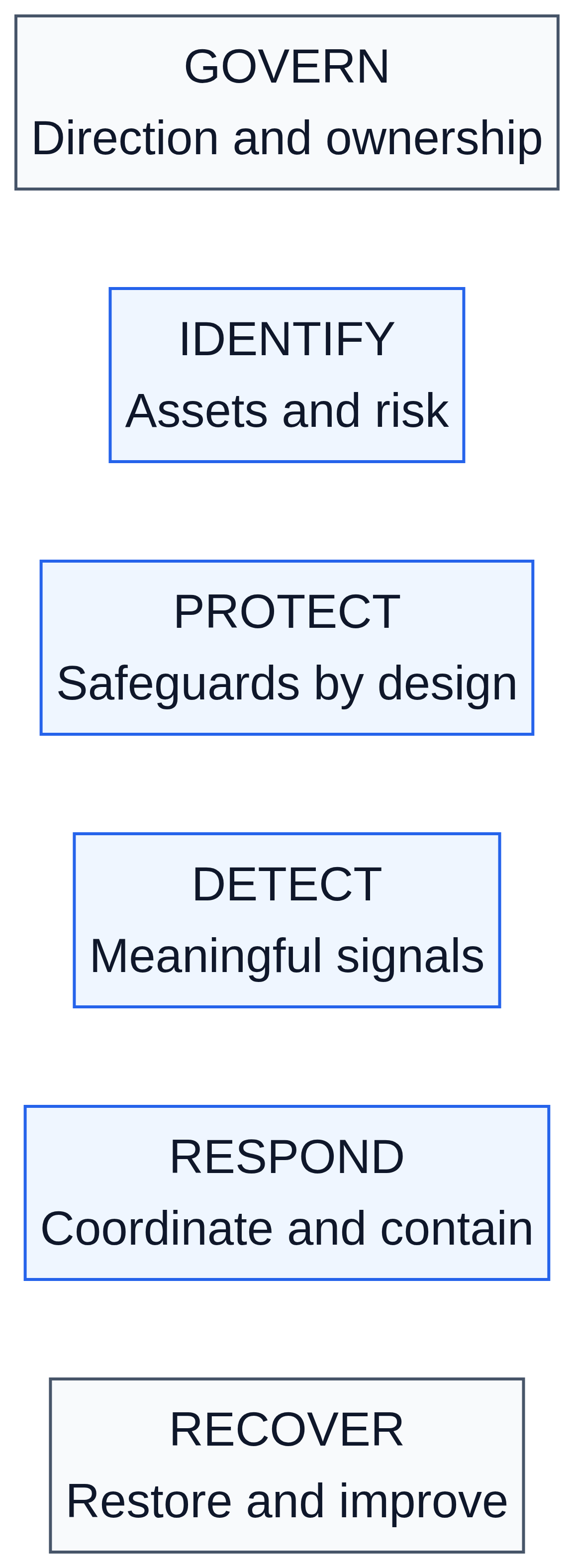
Use the CSF 2.0 as a common language. Its six Functions—Govern, Identify, Protect, Detect, Respond, and Recover—are outcome categories, not a sequence that ends after deployment. Profiles describe a current state and a target state; Tiers characterize the rigor of governance and risk management, from Partial to Adaptive NIST CSF 2.0. That distinction matters: a target Profile is a prioritization tool, not proof that a control is operating.
A useful decision record links each material risk to an owner, a treatment, evidence, and a review date. Treatment may be mitigation, transfer, avoidance, or informed acceptance. “We have a firewall” is not treatment evidence. “Only the payment service can call this endpoint; access is logged; a failed authorization test blocks release” is testable evidence.
Threat model before architecture
A threat model is a structured description of what can be attacked, by whom, through which path, with what consequence, and which safeguards reduce the risk. It is not a one-time diagram. Revisit it when data, trust boundaries, dependencies, deployment environments, or attacker capabilities change.
Begin with assets and abuse cases, not a favorite framework. Draw the data flows between browser or client, API, worker, database, administrator, identity provider, build system, and third parties. Mark every trust boundary: crossing from an internet-facing component to an internal service is a boundary; so is passing from a build runner to a release repository. Ask “What if this component is malicious?” as well as “What if it is unavailable?”
For each boundary, record assumptions and controls. Examples include a stolen session token, a compromised package, a malicious insider, a replayed webhook, a database export, or a build pipeline that signs an altered artifact. Rank scenarios by plausible likelihood and business impact. A simple risk score is useful only if its assumptions are visible; false precision is worse than a short, honest rationale.
CISA’s secure-by-design guidance defines secure-by-design products as those that reasonably protect customers against malicious access to devices, data, and connected infrastructure, and recommends a tailored threat model during product development CISA, _Shifting the Balance of Cybersecurity Risk_. Turn the model into requirements: “tenant A cannot read tenant B,” “an operator cannot approve their own high-risk change,” or “a leaked build token cannot publish without a second control.” Link each requirement to a design choice and a test.
Govern risk as an engineering constraint
Governance is how security decisions acquire authority, money, and follow-through. Assign an accountable owner for each service and risk; define who can accept residual risk; establish escalation thresholds; and ensure product, engineering, legal, privacy, and operations can make a joint decision. CISA’s secure-by-design guidance argues that leadership must make security a business priority rather than leave it solely to technical staff CISA, _Shifting the Balance_.
Keep policy short and operational. A policy can require strong authentication for privileged access, supported software versions, auditable changes, vulnerability response, and tested recovery. A standard can define concrete control objectives. Procedures explain how a team meets them. Standards and procedures should allow compensating controls when a literal implementation is infeasible, but the exception must document the risk, substitute safeguard, owner, expiry, and evidence.
Separate compliance evidence from security outcomes. A signed checklist shows that someone asserted completion; a passing authorization test, a recovered backup, or a measured detection shows capability. Review material risks at a regular operating rhythm, not only before an audit. A quarterly review can ask which assumptions changed, which exceptions expired, and whether metrics reflect exposure rather than activity.
Put Zero Trust at every boundary
Zero Trust is an architecture approach that does not grant implicit trust based on network location. NIST SP 800-207 describes policy decisions that use information about the requester, resource, asset posture, and context, with enforcement points that permit or deny a particular request NIST SP 800-207. Its scope is architectural guidance, not a promise that buying one product creates Zero Trust.
Apply the idea to human, machine, and service-to-service access. Authenticate the workload, authorize the specific action, constrain the audience, and make the decision close to the resource. A private subnet is useful for reducing exposure, but it is not authorization. A service that accepts any caller with a network route has merely moved the perimeter.
Choose boundaries that limit blast radius: separate administration from customer traffic; isolate build, test, and production; segment tenants logically and, when risk warrants, physically; restrict egress from sensitive workers; and protect control planes separately from data planes. Make boundary crossings explicit in diagrams and telemetry. The trade-off is operational complexity: more policy points can create latency, outages, and debugging burden. Start with crown-jewel data and privileged paths, then expand as policy quality and observability improve.
Make identity and least privilege concrete
Least privilege means granting only the permissions, scope, and duration required for an action. It applies to people, services, jobs, devices, and automation. Use separate identities for humans and workloads; avoid shared accounts; make privileged access time-bound; and review unused permissions. A role that says “administrator” everywhere is convenient but destroys accountability and enlarges blast radius.
Authentication answers “who or what is presenting a credential?” Authorization answers “may this subject perform this action on this resource under these conditions?” Keep them separate. Model permissions as verbs and resources—read invoice 123, rotate key for service A, deploy artifact hash H—not merely broad groups. Deny by default where a missing rule would otherwise expose sensitive data, and test both allowed and denied paths.
The current NIST Digital Identity Guidelines, SP 800-63-4 (July 2025), cover identity proofing, enrollment, authenticators, management, authentication protocols, federation, and assertions. They use risk to select and tailor identity assurance levels and require documented decisions for applicable government services NIST SP 800-63-4. XQO need not adopt those federal requirements wholesale, but the risk-based pattern is broadly useful: stronger proofing and authentication for higher-impact actions, phishing-resistant methods for privileged access where feasible, and recovery processes that are not weaker than login.
Measure identity quality with stale-account age, privileged-session coverage, emergency-access use, authorization-denial rates, and time to remove access after role change. Do not optimize for “zero denials”; denials can indicate healthy enforcement or a broken workflow. Pair them with user-friction and incident data.
Secure defaults reduce the human attack surface
A secure default protects a new installation or tenant before an expert has tuned it. CISA recommends products secure “out of the box,” with security capabilities available without an additional charge, so customers do not carry avoidable configuration risk CISA, _Shifting the Balance_.
Default to private data, authenticated administrative interfaces, encrypted transport, narrow network exposure, safe cookie attributes, bounded request sizes, and disabled diagnostic endpoints. Require an explicit, logged decision to weaken a default. Avoid secrets in example configurations, permissive cross-origin rules, wildcard IAM policies, and default credentials. Make the safe path the shortest path in the deployment interface.
Defaults must be observable and reversible. Document every default, its rationale, and how a customer can verify it. Add configuration tests to continuous integration and a deployment check that flags drift. A secure default that silently changes between releases is a change-management risk, so publish migration notes and preserve compatibility where possible.
There is a trade-off between safety and flexibility. A strict default can break legitimate integrations or create support load. Resolve this with explicit opt-in, scoped exceptions, good error messages, and a warning that names the exposure—not by silently choosing convenience.
Treat secrets and keys as a lifecycle
A password, API token, private key, or signing key is a capability, not ordinary configuration. Store secrets in a managed secret system or equivalent protected store; inject them at runtime; keep them out of source control, logs, tickets, and container images; and give each workload a separate credential. Scan commits and artifacts, but assume scanners miss things and a detected secret may already be copied.
Key management includes generation, distribution, storage, backup, archive, recovery, use, revocation, and destruction. NIST SP 800-57 Part 1 Rev. 5 defines that lifecycle and discusses key states, compromise, cryptoperiods, and replacement NIST SP 800-57 Part 1 Rev. 5. A rotation calendar alone is not a lifecycle: define who owns a key, what it protects, how compromise is detected, how dependent systems migrate, and how old material is disabled and destroyed.
Prefer short-lived credentials and automatic rotation where the dependency supports it. Protect root or signing keys with stronger controls, separation of duties, and, where justified, hardware-backed protection. Test restoration of encrypted backups: losing the key can be as damaging as losing the data. When a credential leaks, revoke first, investigate use, scope the blast radius, and issue a replacement; do not merely edit the leaked value and assume history is erased.
Manage vulnerabilities and dependencies by exposure
Vulnerability management is a risk-prioritization loop, not a race to make a dashboard green. Maintain an inventory of applications, services, versions, owners, dependencies, and exposure. Identify affected assets, determine exploitability and business impact, choose patch, mitigation, isolation, replacement, or acceptance, then verify the result.
NIST SP 800-40 Rev. 4 frames enterprise patch management as identifying, prioritizing, acquiring, installing, and verifying patches and updates, and warns that simplistic counts do not show risk NIST SP 800-40 Rev. 4. Combine severity with internet exposure, reachable attack path, privilege required, data value, exploit evidence, and compensating controls. CISA’s Known Exploited Vulnerabilities Catalog is an authoritative list of vulnerabilities exploited in the wild; CISA says to use it as an input to prioritization, not as a complete vulnerability inventory CISA KEV Catalog.
For dependencies, pin versions and trusted registries, review transitive packages, generate a software bill of materials (SBOM), and monitor advisories. A lockfile improves repeatability but is not proof of safety. Test updates in a representative environment and make rollback possible. When a fix is unavailable, document temporary mitigations and an expiry date.
Useful measures include time to remediate exploited vulnerabilities by criticality, percentage of production assets with an owner, unsupported-component age, and exception age. Avoid a target such as “patch 95%” without weighting asset importance; it can reward closing low-risk tickets while an exposed critical system remains open.
Build software and supply chains for verification
Secure development makes security work visible in the software lifecycle. NIST SP 800-218, SSDF Version 1.1 (February 2022), is a set of high-level practices intended to integrate into different development lifecycle models; it is not a single prescribed lifecycle NIST SSDF. Use its vocabulary to prepare the organization, protect the software and build environment, produce well-secured software, and respond to vulnerabilities.
Require security acceptance criteria at design, code review, test, and release. Review critical code—especially cryptography, privilege changes, protected-resource access, and security boundaries—using both human review and automated analysis. OWASP’s ASVS provides a basis for testing web application technical security controls and a requirements list for secure development; its project page identifies version 5.0.0 as the current stable version OWASP ASVS. Pin the ASVS version in internal requirements because identifiers can change.
Protect the pipeline as production infrastructure. Use isolated build workers, short-lived credentials, branch and release protections, dependency provenance, reproducible or at least repeatable builds where practical, and signed artifacts. Verify signatures and hashes at deployment, but remember that signing a malicious build only proves that an authorized key signed it. Protect source, build configuration, signing keys, and release permissions as separate assets.
CISA’s Enduring Security Framework developer guidance recommends practices such as architecture review, threat modeling, code review, testing, hardening build environments, continuous verification of third-party binaries, open-source management, and retaining evidence such as SBOMs and threat-model results CISA, _Securing the Software Supply Chain: Developers_. The trade-off is slower delivery and engineering time. Reduce that cost with reusable secure components, paved-road templates, fast automated tests, and risk-based review depth rather than treating every change as a bespoke audit.
Log for detection, not for storage
A log is useful when it helps answer who did what, to which resource, when, from where, and with what result. Prioritize authentication and authorization decisions, privilege changes, key and secret use, administrative actions, data exports, configuration changes, deployment events, and security-control failures. Include a correlation identifier, service identity, resource identifier, outcome, and reliable timestamp while minimizing sensitive payloads.
Centralize security-relevant events, restrict who can alter them, synchronize time, define retention, and test that alerts arrive. Protect privacy by collecting the least data needed, controlling access to logs, and setting deletion rules. More telemetry is not automatically better: noisy alerts exhaust analysts and increase the chance that a real signal is ignored.
Detection logic should express a threat-model hypothesis. Examples: impossible travel for a privileged identity, an unusual bulk export, a service calling an unexpected endpoint, repeated authorization failures, or a release signed outside the approved workflow. Tune thresholds against normal behavior and document what an alert owner does next. Measure time to detect, triage, contain, and close; also measure false-positive rate and the percentage of critical paths with usable telemetry.
NIST’s CSF 2.0 keeps Detect alongside Govern, Identify, Protect, Respond, and Recover because prevention cannot eliminate residual risk NIST CSF 2.0. Detection should therefore be designed alongside controls, not added after a breach.
Respond and recover as designed capabilities
An incident is a security event that requires coordinated action; response is not synonymous with “someone opened a ticket.” Define severity by functional impact, information impact, safety, legal duties, and recoverability. Maintain named roles, contact paths, decision authority, evidence-handling procedures, customer and regulator communication criteria, and pre-approved containment actions.
NIST SP 800-61 Rev. 3 (April 2025) is a CSF 2.0 Community Profile. It helps organizations incorporate incident response across cybersecurity risk management and emphasizes preparation, detection, response, recovery, and improvement NIST SP 800-61 Rev. 3. It supersedes Rev. 2; teams should not silently cite the withdrawn older guide as current. Use the current publication while preserving any older playbooks that remain operationally useful after review.
Recovery starts before the incident. Define recovery time and recovery point objectives for important services, maintain isolated or otherwise protected backups, record dependencies, and test restoration from a clean state. Validate that identity, keys, DNS, observability, and deployment tooling work during a recovery scenario. A backup that cannot be restored, or a recovery plan that depends on the compromised identity system, is an assumption—not resilience.
Run tabletop exercises for realistic scenarios: stolen administrator credentials, compromised dependency, destructive ransomware, data exfiltration, or a bad security rule. Capture decisions, time to restore, missing evidence, and follow-up owners. Treat lessons learned as engineering work with due dates, not a retrospective document that nobody revisits.
Make governance measurable
Good metrics connect a control to exposure and outcome. A balanced scorecard might include: percentage of critical services with a current threat model; privileged access using phishing-resistant authentication; authorization tests covering sensitive actions; secrets with an owner and rotation path; production components with an SBOM; exploited-vulnerability remediation time; critical events with complete telemetry; mean time to contain; tested recovery success; and overdue exceptions.
Define each metric precisely. “Threat models current” needs a time window and change trigger. “Coverage” needs a denominator. “Mean time” should not hide a long tail. Segment by service criticality and report trends, not vanity totals. Pair leading indicators—review coverage, backup tests, training completion—with lagging indicators—incidents, unauthorized access, data loss, and downtime.
Use a risk register to explain what metrics cannot. An organization can have excellent patch speed and still expose an authorization flaw. Conversely, a deliberate exception can be reasonable when documented and monitored. CSF Profiles and Tiers help communicate current and target posture, but neither is a certification badge NIST CSF 2.0.
Adopt in phases and choose trade-offs
Phase one: establish control of the map. Inventory services, data, identities, dependencies, owners, and external exposure. Pick the few systems whose failure would hurt most. Create threat models for their critical flows; turn the highest risks into requirements. Enable centralized authentication, remove shared privileged accounts, protect backups, and publish an incident contact path.
Phase two: make the safe path repeatable. Implement secure defaults, least-privilege roles, secret storage, dependency pinning, patch prioritization, protected CI/CD, critical-code review, and baseline logging. Add automated tests for tenant isolation, authorization denial, configuration drift, and release integrity. Start an exception register with expiry dates.
Phase three: improve detection and recovery. Connect security-relevant logs to an alert workflow. Exercise containment and restoration. Rotate credentials and keys through tested processes. Add SBOM generation and supplier questions to procurement. Use exploit intelligence, including KEV, to reprioritize exposure rather than treating vulnerability severity as static.
Phase four: optimize by evidence. Compare current and target CSF Profiles, retire controls that do not reduce meaningful risk, improve noisy detections, and invest in automation where repeated human decisions cause delay or error. Expand Zero Trust boundaries from the most sensitive paths. Publish security outcomes and known limitations honestly; secure-by-design is an iterative state, not a marketing adjective.
The trade-offs are real. Stronger authentication can increase friction; segmentation can complicate operations; logging can increase cost and privacy risk; upgrades can break compatibility; and review gates can slow a release. Handle them explicitly through risk-based tailoring, staged rollout, good defaults, compensating controls, and measured outcomes. The answer to friction is not to remove the control invisibly; it is to improve the design around it.
Conclusion: security is the system
Security becomes durable when it is distributed through design decisions, boundaries, identities, code, dependencies, telemetry, response, and governance. Products can help implement those layers, but no product can decide XQO’s acceptable risk, model every trust boundary, validate every authorization rule, or restore a service after an untested failure.
Start with outcomes and a threat model. Use CSF 2.0 to organize the conversation, Zero Trust to make boundaries explicit, SSDF and ASVS to make engineering verifiable, and current NIST and CISA guidance to shape identity, keys, patching, supply-chain, response, and measurement. Build the smallest operating loop that reduces the most consequential risk, then improve it with evidence. That is security by design: not a product at the edge, but a layer in every decision.
References and further reading
- The NIST Cybersecurity Framework (CSF) 2.0
- Zero Trust Architecture, SP 800-207
- Shifting the Balance of Cybersecurity Risk: Principles and Approaches for Secure by Design Software
- Secure Software Development Framework (SSDF) Version 1.1, SP 800-218
- Digital Identity Guidelines, SP 800-63-4
- Recommendation for Key Management: Part 1—General, SP 800-57 Part 1 Rev. 5
- Guide to Enterprise Patch Management Planning: Preventive Maintenance for Technology, SP 800-40 Rev. 4
- Known Exploited Vulnerabilities Catalog
- OWASP Application Security Verification Standard (ASVS)
- Securing the Software Supply Chain: Recommended Practices Guide for Developers
- Incident Response Recommendations and Considerations for Cybersecurity Risk Management: A CSF 2.0 Community Profile, SP 800-61 Rev. 3
The Domain Control Plane: DNSSEC, Registrar Security and Resilient Brand Infrastructure
Protect brand infrastructure across registrar accounts, DNS delegation, DNSSEC, certificates and email with a resilient domain-control-plane framework.

Preparing for post-quantum cryptography: a practical migration plan
Plan post-quantum cryptography migration through inventory, risk prioritization, hybrid testing, PKI dependencies and safe rollback.

Confidential computing: what hardware isolation protects—and what it does not
Learn what confidential computing and hardware enclaves protect, how attestation and key release work, and where their security limits remain.