Incident reviews without blame
 Founder · Domain Strategist · Author03 Jul 2026 · 16 min read

In this article · 15 sections
- Start with the purpose and the boundary
- Stabilize first, then preserve the record
- Make command visible and communication useful
- Build a timeline from evidence and decisions
- Describe impact before explaining cause
- Map contributing conditions, not one root cause
- Include human factors and psychological safety
- Turn findings into prioritized systemic actions
- Give every action an owner and a due date
- Close the loop and measure learning
- Protect confidentiality without hiding learning
- Communicate findings and maintain trust
- A practical review template
- Conclusion: make learning safer than silence
- References and further reading
An incident review is a decision-making tool, not a courtroom. Its purpose is to turn a service failure, security event, near miss, or confusing recovery into better conditions for the next operator and safer outcomes for users. “Blameless” does not mean that facts are softened, accountability disappears, or deliberate misconduct is ignored. It means the review does not begin by treating a person as the explanation.
Google’s SRE guidance describes a postmortem as a written record of impact, response, causes, and follow-up, and says the work is a learning opportunity rather than punishment Google SRE, _Postmortem Culture_. NIST’s current cybersecurity guidance, SP 800-61 Rev. 3, published in April 2025, places incident response in a continuous-improvement loop rather than a one-time closing ritual. This guide adapts those principles for XQO teams handling technical and operational incidents.
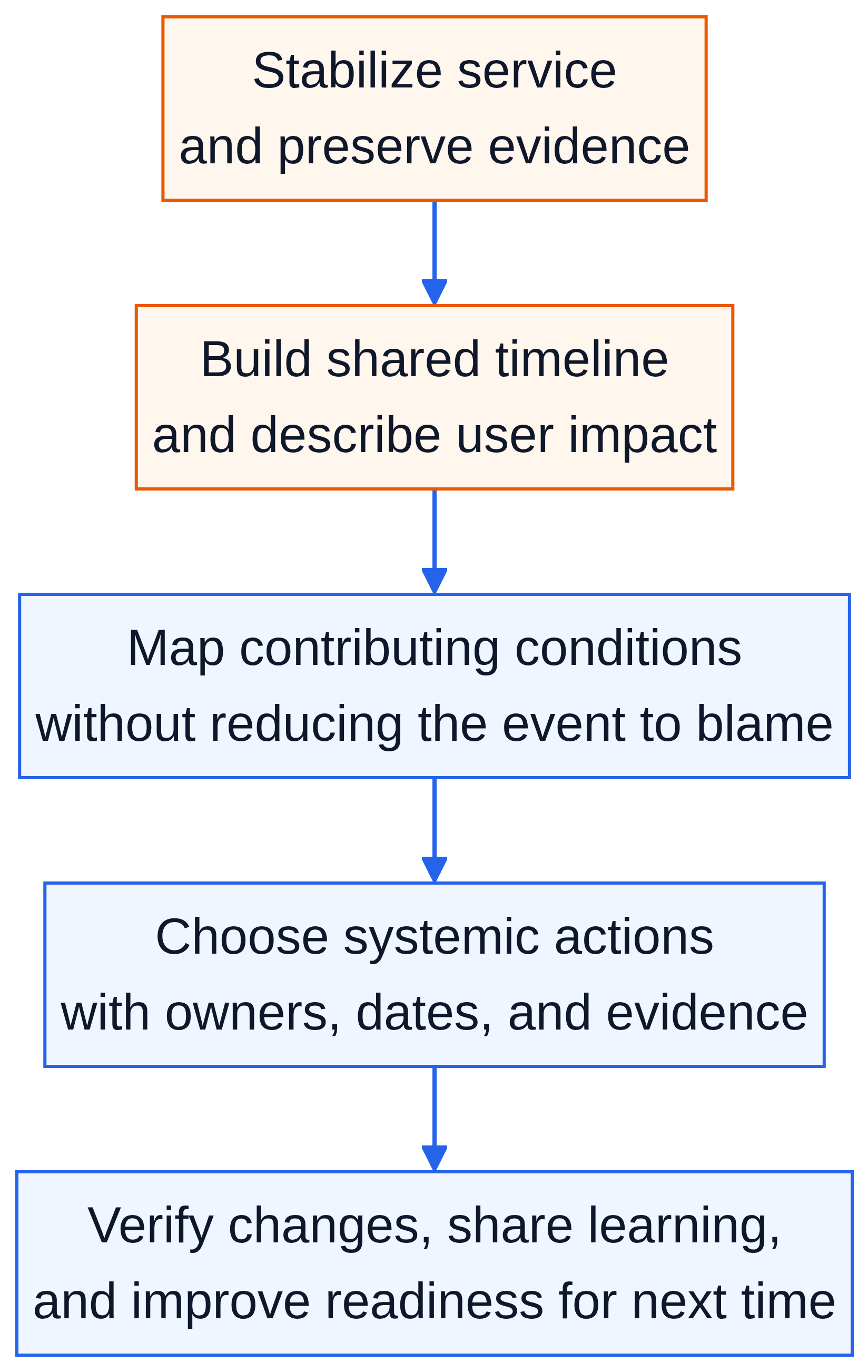 Open the full-size diagram
Start with the purpose and the boundary
Write the review charter before the discussion starts. A useful charter says: establish what happened, understand how work and conditions interacted, preserve evidence, identify risks that remain, and agree on changes that reduce recurrence or impact. It also says what the review is not: an individual performance hearing, a substitute for a security investigation, or a promise that every uncertainty will be resolved.
Separate the learning review from processes that have a different purpose. A suspected crime, intentional abuse, harassment allegation, regulatory inquiry, employment matter, or customer-specific contractual investigation may require a restricted fact-finding process led by appropriate specialists. The learning review can still improve systems, but it must not contaminate evidence, disclose protected information, or make conclusions outside its authority.
This distinction helps people speak accurately. Say “the deployment was approved with the information available at the time” rather than “the engineer caused the outage.” If later evidence indicates a policy violation or deliberate recklessness, route that question to the authorized process; do not smuggle a disciplinary verdict into a technical narrative. A systems review can be candid about an unsafe design, a missing control, or a decision that increased exposure while leaving individual sanctions to the people qualified to decide them.
Stabilize first, then preserve the record
During the incident, service and safety take priority over a polished narrative. Appoint an Incident Commander (IC)—the person who coordinates decisions and information, not necessarily the deepest technical expert. Give the IC authority to set priorities, call for specialists, stop parallel work, and declare when response has moved into recovery. Assign separate leads where useful for operations, communications, security or forensics, and documentation. NIST notes that incident response depends on varied internal and external roles, including leadership, handlers, technology professionals, legal, privacy, and public affairs NIST SP 800-61 Rev. 3.
Use one operational channel or incident document as the source of coordination, and record decisions as they happen. Preserve chat exports, alerts, dashboards, deployment records, tickets, configuration snapshots, relevant code revisions, and command output according to policy. Do not “clean up” logs by overwriting them, restart a system in a way that destroys volatile evidence without considering the investigative need, or ask responders to reconstruct a conversation from memory when the original exists.
For a security incident, evidence handling needs special discipline. CISA’s Federal Government Cybersecurity Incident and Vulnerability Response Playbooks call for collecting and preserving data, logging how and when it was acquired and by whom, and planning notification and evidence sharing with law enforcement. Apply the same mindset proportionately to non-security incidents: identify the record, its source, its time basis, its custodian, and any transformation applied.
Make command visible and communication useful
An IC should make the operating model explicit: who is coordinating, who is investigating, who can approve risky changes, where updates are posted, and what conditions end the incident. A technical lead can test hypotheses while the IC protects attention from a crowd of well-intentioned suggestions. A communications lead translates confirmed facts for affected users, executives, support, and partners; they should not speculate to fill silence.
A good internal update answers four questions: what is affected, what is known, what is being done, and what is not yet known. Include the next decision point or information needed, but avoid invented precision. “We are testing whether the cache change is contributing” is more useful than “the cache caused it” when the evidence is incomplete. Mark hypotheses as hypotheses and record when they are confirmed, rejected, or superseded.
The review should examine command as part of the system. Did responders know who could make a rollback decision? Were escalation paths reachable? Did a handoff lose context? Did a noisy channel bury a critical signal? These are design questions, not accusations. Google’s example postmortem shows why an incident record benefits from named roles, a screenplay-like timeline, supporting links, and explicit action-item status Google SRE, _Example Postmortem_.
Do not confuse broad distribution with indiscriminate distribution. Share operational learning with people who can use it, redact personal or sensitive data, and give external audiences only verified information appropriate to their needs. Candor is strongest when the audience, purpose, and handling rules are clear.
Build a timeline from evidence and decisions
Start with a rough timeline while memories and artifacts are available, then refine it from records. Use a consistent time zone and show uncertainty explicitly. Include at least: the first relevant change or signal, detection, declaration, major hypotheses, decisions and approvals, mitigations, customer-visible effects, recovery checks, and closure. Record both system events and human events: “alert acknowledged,” “rollback proposed,” “rollback approved,” and “rollback completed” are different facts.
Invite every incident participant to annotate the draft. Google’s workbook recommends including participants in authoring because a single team can miss contributing factors, and it emphasizes a structured review to prevent blameful language from spreading Google SRE, _Postmortem Culture_. Ask for sources beside important entries: a log link, change identifier, monitoring graph, ticket, or contemporaneous message. If two records disagree, preserve the disagreement and state how it will be resolved.
A timeline is not a transcript. Select events that explain detection, decisions, uncertainty, impact, and recovery. A compact entry might read: “09:14 UTC — error rate crossed the alert threshold; on-call acknowledged; dashboard showed payment requests failing in one region.” Avoid hindsight verbs such as “obviously” and “should have known.” At the time, the operator may have seen a partial signal, competing alerts, or a plausible alternative.
End the timeline with an evidence note: what was retained, what was unavailable, which clocks were unreliable, and which conclusions are provisional. That protects the review from false certainty and creates a concrete improvement target when observability was insufficient.
Describe impact before explaining cause
Impact is the effect on users, customers, partners, staff, data, safety, revenue, or obligations—not the emotional intensity of the response. Describe who or what was affected, which functions degraded, the duration or window supported by evidence, the geographic or tenant scope, and what remained healthy. If measurement is incomplete, say so and explain the estimation method.
Separate direct impact from operational burden. “Users could not submit orders in region A” is direct impact. “Support received a surge of contacts and responders worked around an unavailable dashboard” describes secondary effects that may reveal resilience gaps. Include data integrity, privacy, or security implications even when no confirmed misuse occurred; distinguish “not observed” from “did not happen.”
Avoid turning a single metric into the whole story. Availability may look normal while latency, failed retries, stale data, accessibility, or a particular customer workflow is impaired. Ask representatives from support, product, security, and operations what users experienced. The review should also record what went well: a rollback was safe, a dependency remained available, or a customer signal shortened diagnosis. Positive evidence helps preserve useful controls instead of replacing them reflexively.
Google’s postmortem model explicitly separates summary, impact, root causes, trigger, resolution, lessons learned, and timeline Google SRE, _Example Postmortem_. Keeping those fields distinct prevents the familiar error of declaring a technical cause while leaving the actual user harm vague.
Map contributing conditions, not one root cause
“Root cause” is often too singular for a complex incident. Use a causal map: initiating event, technical mechanisms, contributing conditions, detection gaps, response constraints, and recovery safeguards. A condition is causal when changing it would plausibly alter the likelihood, timing, detectability, or impact of the event. Label the confidence of each link.
Ask questions that reveal the system around a decision. What information was available? What made the chosen action reasonable? What competing goals or time pressure existed? Which defaults, interfaces, runbooks, permissions, dependencies, staffing patterns, or incentives shaped the work? Were warnings visible but unactionable? Was the normal path different from the documented path? Could another trained person have made the same choice under those conditions?
Use “why” questions carefully. Five Whys can expose a chain, but it can also force a neat story onto a branching system. Pair it with a timeline, fault tree, change review, or barrier analysis as appropriate. The UK Health and Safety Executive says investigations should ask why human failures occurred and find underlying or latent causes, rather than stopping at the visible error HSE, _Human factors in accident investigations_. The AHRQ CANDOR guide likewise says the sole objective of event investigation is prevention, and that system factors can facilitate an error AHRQ, _System-Focused Event Investigation and Analysis Guide_.
Do not erase agency. Record choices and their effects, but analyze them in context. “A flag was enabled” is a fact; “the engineer was careless” is an unsupported judgment unless a separate process establishes it.
Include human factors and psychological safety
Human factors are the relationships among people, tools, tasks, and the environment in which work occurs. Review fatigue, interruptions, workload, handoffs, interface design, alert quality, training, role clarity, incentives, and local workarounds. A workaround is often evidence that the designed process does not fit the real one; it deserves investigation, not automatic condemnation.
Psychological safety means that people can raise concerns, ask for help, and report bad news without expecting humiliation or retaliation. It is a working condition, not a slogan. A systematic review of healthcare research found that speaking up and error reporting are shaped by individual and organizational factors, including perceptions of psychological safety Wawersik et al., _Individual Characteristics That Promote or Prevent Psychological Safety and Error Reporting in Healthcare_. The domain differs from technology operations, so apply the finding cautiously: it supports attention to reporting conditions, not a guaranteed numerical effect.
Make safety observable in the meeting. Begin by stating that the goal is learning and that questions should address conditions and decisions. Let participants describe the work in their own words before showing a preferred diagram. Interview people individually when a group dynamic could suppress detail; AHRQ recommends protected, focused interviews and warns that a supervisor’s presence may reduce candor AHRQ CANDOR guide. Thank people for surfacing uncomfortable evidence, including a missed warning or an unsafe incentive.
Blameless language is precise language. Replace “failed to follow the runbook” with “the runbook required a permission the responder did not have, and the escalation path was unclear,” if that is what the evidence shows. If a person made an understandable mistake, support them; if conduct appears knowingly dangerous, investigate it fairly under the appropriate accountability process.
Turn findings into prioritized systemic actions
An action item should change a condition, not merely restate regret. Strong actions alter design, automation, validation, access, observability, staffing, decision rights, recovery options, or practice. “Be more careful” is not an intervention. “Add a preflight check that blocks this incompatible configuration and alert on the rejected state” is testable, though it still needs a product owner and acceptance evidence.
Prioritize by expected reduction in risk and impact, reach across failure modes, feasibility, and dependency. A near-term containment may be appropriate while a deeper redesign is funded. Prefer layered controls: prevent an unsafe state, detect it quickly, limit blast radius, make recovery reversible, and learn when a control fails. Do not create a new alert simply because alerts feel responsive; Google’s example warns that knee-jerk action items can be extreme or target a symptom when tests or design changes would catch the issue earlier Google SRE, _Example Postmortem_.
Classify each action as prevent, detect, mitigate, recover, clarify, or learn. Write a completion test: a pull request is not enough if the control is not deployed; a new runbook is not enough if the intended responder cannot find or use it; a tabletop is not enough if it does not exercise the disputed decision. Capture residual risk and explicitly record actions rejected as disproportionate, so the decision is not reopened by accident.
A review may produce a small number of high-leverage changes rather than a long wish list. Include the evidence behind priority and the failure modes each action addresses. If an action cannot be funded or owned, mark the risk accepted by the authorized decision-maker instead of hiding it in prose.
Give every action an owner and a due date
Ownership means a named person is accountable for moving the work to an accepted state; it does not mean that person must perform every task. Each action needs a sponsor with authority, an implementer, a precise outcome, dependencies, acceptance evidence, status, and due date. Use a ticket or comparable system that survives the review meeting and remains visible after the incident fades.
Choose due dates based on risk, dependencies, and available capacity—not a ritual calendar. A critical exposure may need immediate containment and a separately scheduled redesign; a low-risk documentation improvement may wait. If the date slips, record why, reassess exposure, and escalate when the residual risk is no longer acceptable. Changing a date is healthier than leaving a misleading “on track” status.
Review action quality before closing the article. Ask whether it addresses a contributing condition, whether the owner can influence it, whether success is observable, and whether another failure mode could bypass it. NIST’s SP 800-61 Rev. 3 frames lessons from incident response, exercises, and operational processes as inputs to an improvement category that should inform broader cybersecurity risk management NIST SP 800-61 Rev. 3. Google’s workbook similarly recommends tracking action-item closeout rather than rewarding documentation alone Google SRE Workbook.
An action is not complete when someone says “done.” Attach the deployed change, test result, updated policy, exercise observation, or monitoring evidence. Have a reviewer independent of the implementer verify the acceptance condition when the risk warrants it.
Close the loop and measure learning
Follow-up is where a review becomes an operational capability. Confirm that actions shipped, controls work in the real environment, documentation matches the workflow, and people know about the change. Revisit the incident when a related change, near miss, exercise, or new signal tests the same assumptions. If an action created alert fatigue, friction, or a new failure mode, revise it rather than defending its existence.
Measure the process without turning metrics into a performance scoreboard. Useful signals include the proportion of actions with owners and acceptance evidence, overdue risk accepted or escalated, recurrence of related failure modes, time to detect and restore when measured consistently, quality of impact assessment, participation across relevant roles, and whether findings are shared beyond the originating team. Trends are clues, not proof of causation. More reports can mean more failures, better detection, or greater trust; fewer reports can mean improvement or silence.
NIST’s model places continuous improvement between preparation and response, with lessons analyzed, prioritized, communicated, and fed back into the organization NIST SP 800-61 Rev. 3. The HSE describes the difference between passive learning—identifying lessons—and active learning—embedding them in practice—and warns that failing to implement earlier recommendations is itself a learning failure HSE, _Learning organisations_.
Run exercises against the changed process. NIST SP 800-84 describes test, training, and exercise programs as ways to prepare, respond, manage, and recover from adverse IT situations NIST SP 800-84. An exercise should test decision rights, evidence access, third-party contact, and communication—not just whether people can recite a checklist.
Protect confidentiality without hiding learning
Set handling rules before collecting sensitive material. Limit personal data, credentials, customer identifiers, and speculative statements. Redact copies for broad learning; retain restricted originals only where necessary and with a named custodian. Access should follow the purpose of the review and the organization’s security, privacy, retention, and employment policies.
Do not promise that an incident review is legally privileged or confidential merely because a lawyer attends. Privilege, discovery, notification, data protection, labor, and contractual duties vary by jurisdiction and circumstance. Engage legal counsel early when the incident may involve regulated data, law enforcement, litigation, material customer obligations, or a reporting decision. NIST identifies legal, privacy, and public-affairs roles as part of incident response and notes that legal experts may review compliance, contracts, and potential legal ramifications NIST SP 800-61 Rev. 3.
Keep two records when needed: a learning review that contains actionable system findings and a restricted investigative record controlled by the appropriate function. Cross-reference them without copying unnecessary sensitive content. Do not use confidentiality as a reason to omit a known control weakness from everyone who can fix it; instead, share the minimum necessary facts with the right audience.
For cyber incidents, follow applicable notification and evidence-preservation requirements. CISA’s guidance emphasizes centralized logging, out-of-band preservation, documented acquisition, and post-incident reporting CISA, _Federal Government Cybersecurity Incident and Vulnerability Response Playbooks_. A recent CISA advisory also demonstrates how missed patching, untested response plans, and unreviewed alerts can combine into delayed detection CISA, _Lessons Learned from an Incident Response Engagement_. Treat these as evidence-backed lessons, not as a universal checklist.
Communicate findings and maintain trust
Publish a clear internal summary after review: what happened, impact, contributing conditions, what changed, residual risk, and where to ask questions. Use plain language and distinguish confirmed facts, informed judgments, and open questions. Share broadly enough that other teams can recognize similar patterns, but remove details that enable misuse or identify individuals unnecessarily.
Give affected people an opportunity to correct factual errors. Do not require participants to agree with an interpretation before publishing; record material dissent and the evidence behind it. If an external statement is needed, coordinate with communications, legal, privacy, security, and the responsible business owner. A public message should address user impact, current protection, and next steps without exposing investigation-sensitive details or making claims that evidence cannot support.
Psychological safety is maintained by what happens after publication. Leaders should model curiosity, credit people who escalate, and challenge blameful language even when it comes from a senior voice. The AHRQ review of a nonpunitive error-review redesign highlights transparency, skilled difficult conversations, and executive support as practical conditions for trust Neiswender et al., _Rooting an error review process in just culture_. That is compatible with accountability: support normal error, coach risky patterns, and use a fair process for deliberate or reckless conduct.
A mature review leaves behind more than a document. It leaves a shared mental model, a safer decision path, and evidence that raising a concern leads to action.
A practical review template
Use the following structure, adapting it to the incident and handling level:
- Status and scope: incident identifier, classification, reviewers, handling rules, and unresolved questions.
- Summary and impact: what users or systems experienced, affected scope, data or safety implications, and confidence in measurements.
- Response: IC and supporting roles, major decisions, communications, mitigations, recovery validation, and what went well.
- Evidence and timeline: time basis, sources, preservation notes, decisions, hypotheses, and uncertainty.
- Causal analysis: initiating event, mechanisms, contributing conditions, human factors, barriers that failed or worked, and alternative explanations considered.
- Actions: priority, category, owner, sponsor, due date, dependencies, acceptance evidence, status, and residual risk.
- Follow-up: review date or trigger, exercise plan, metrics, related incidents, and escalation path for overdue risk.
Before sign-off, ask: Can a new responder understand the system without knowing the people involved? Does the impact stand on its own? Are causes supported by evidence rather than hindsight? Does every important action have authority and acceptance criteria? Are confidentiality boundaries real and documented? Has the review been shared with those who can prevent a similar event?
Conclusion: make learning safer than silence
Blameless incident reviews are rigorous because they investigate work as it actually happened. They preserve evidence, clarify command, describe impact, include human and organizational conditions, and turn findings into owned changes. They also keep accountability precise: systems are redesigned, normal mistakes are supported, risky patterns are coached, and deliberate misconduct is handled through a fair process rather than disguised as learning.
For XQO, the durable test is not whether a review sounds calm. It is whether people can report weak signals, responders can act with clear authority, leaders can see residual risk, and promised changes are verified after the meeting. When an incident produces better conditions for the next decision, the organization has converted failure into capability without sacrificing truth.
References and further reading
- Google SRE, Postmortem Culture: Learning from Failure
- Google SRE Workbook, Postmortem Culture
- Google SRE, Example Postmortem
- NIST SP 800-61 Rev. 3, Incident Response Recommendations and Considerations for Cybersecurity Risk Management: A CSF 2.0 Community Profile
- CISA, Federal Government Cybersecurity Incident and Vulnerability Response Playbooks
- CISA, CISA Shares Lessons Learned from an Incident Response Engagement
- NIST SP 800-84, Guide to Test, Training, and Exercise Programs for IT Plans and Capabilities
- AHRQ, System-Focused Event Investigation and Analysis Guide
- Wawersik et al., Individual Characteristics That Promote or Prevent Psychological Safety and Error Reporting in Healthcare: A Systematic Review
- Neiswender et al., Rooting an error review process in just culture: lessons learned
- UK HSE, Human factors in accident investigations
- UK HSE, Learning organisations